
Primary Research Guide for Strategy Teams
For Clients

Every investment and strategy decision depends on having the right evidence at the right stage. Primary research helps teams validate assumptions, understand market dynamics, and identify risks that may not appear through secondary research alone.
The challenge is choosing the method that best fits the decision.
Surveys help measure patterns across larger audiences. Expert interviews provide deeper context into operational realities, competitive dynamics, and industry behavior.
According to the 2025 GreenBook GRIT Insights Practice Report, both survey research and qualitative methods, including in-depth interviews, remain core approaches used for different research objectives.
The key question is which method provides the insight needed to make a confident decision.
Why the Right Primary Research Method Matters
Different strategic decisions require different types of evidence.
- A commercial due diligence project may require validation of market assumptions, competitive positioning, and customer behavior.
- A market-entry study may require deeper understanding of local regulations, customer needs, and industry dynamics.
- A product expansion project may require both exploratory insights and quantitative validation.
- Selecting the right primary research method early helps teams focus resources on the information that can influence the decision most.
Key Insight
The value of primary research comes from matching the method to the business question.
Expert Interviews vs. Surveys in Primary Research
Expert interviews and surveys serve different purposes. The right choice depends on the level of understanding and validation required.
Speed
Expert interviews are often preferred when teams need fast access to specialized knowledge.
They allow researchers to:
- speak directly with experienced practitioners
- explore unexpected findings
- ask follow-up questions in real time
This makes them particularly useful for compressed timelines, such as commercial due diligence projects.
Surveys typically require questionnaire design, respondent recruitment, fieldwork, and analysis. They are better suited for projects requiring broader market validation across larger respondent groups.
→ Learn more: Expert Network Pricing Explained: Is Arches Expensive?
Depth of Insight
Expert interviews help teams understand the factors behind market behavior.
They provide insight into:
- operational challenges
- competitive dynamics
- customer decision-making
- adoption barriers
Surveys are effective when teams need to measure patterns across a broader audience, such as customer preferences, satisfaction levels, or adoption trends.
Key Insight
Expert interviews explain why a market behaves the way it does. Surveys help determine how widely those patterns apply.
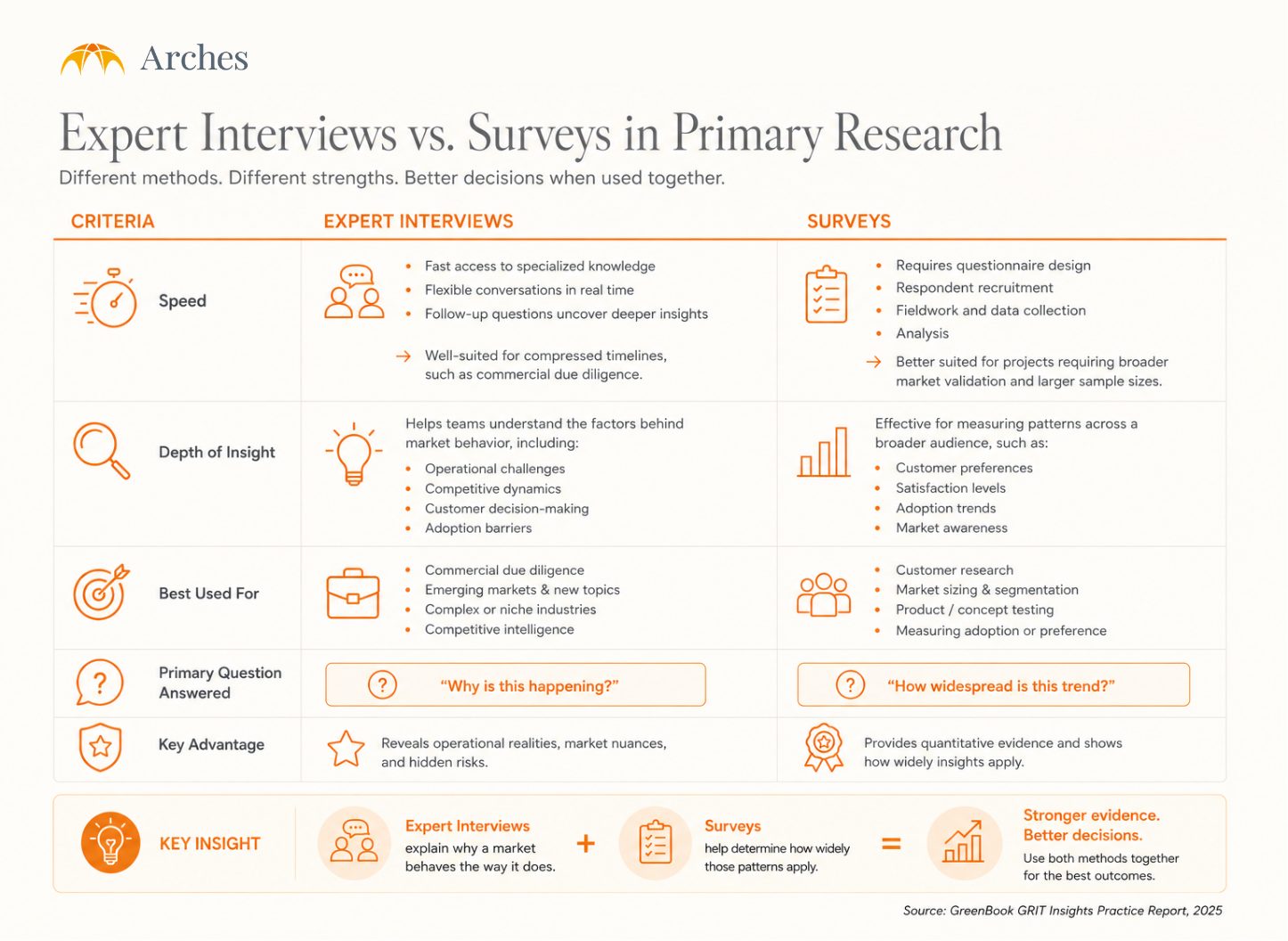
Expert interviews vs Surveys in primary research
How Strategy Teams Use Primary Research Methods Together
The strongest research programs often combine qualitative and quantitative approaches.
A survey can reveal what customers or market participants are doing, but it may not explain the operational factors driving those behaviors.
Expert interviews provide that context by helping teams understand industry dynamics, identify assumptions, and uncover risks that may not appear in existing data.
A peer-reviewed paper published by Cambridge University Press highlights that expert interviews are particularly valuable when researchers need to understand complex processes, tacit knowledge, and topics where public information remains limited or incomplete.
Build Context Before Measuring Scale
Many consulting and investment teams begin with expert interviews to identify:
- market dynamics
- competitive factors
- operational risks
These conversations help refine research questions before broader validation and then test how widely these findings apply across the market.
Key Insight
Expert interviews build context. Surveys validate findings. Together, they provide stronger evidence for investment and strategy decisions.
Primary Research in Practice: Lessons from the CSDDD Study
Emerging markets and regulatory changes often require insights beyond publicly available information.
When researchers developed an implementation framework for the Corporate Sustainability Due Diligence Directive (CSDDD), secondary research alone could not fully explain how organizations were preparing for the regulation or where practical challenges would emerge.
To address these gaps, the study conducted 33 expert interviews with specialists from business, academia, and policy to gather firsthand perspectives on an evolving topic.
Key Insight
For complex or rapidly changing topics, expert interviews help uncover practical realities that may not yet appear in market reports or structured datasets.
How Expert Networks Strengthen Primary Research
The effectiveness of primary research depends heavily on accessing the right perspectives.
For investment and strategy teams, the challenge is often finding practitioners who can explain market dynamics, validate assumptions, and provide operational insight within limited timelines.
Expert networks help bridge this gap by connecting teams with experienced professionals across industries and markets.
→ Read: Right Expert Network Provider: A Guide for PE & Consultants
How Arches Supports Primary Research
Arches supports primary research through custom expert recruitment, helping consulting firms, investors, and strategy teams access hard-to-reach experts for due diligence, market-entry, and strategic research projects.
With global coverage, cross-border expertise, and a team spanning 15+ nationalities, Arches helps clients gather the insights needed to make better-informed decisions.
→ Speak with the Arches team to connect with industry experts for your next research project.
FAQ
What is primary research?
Primary research is the process of collecting firsthand information directly from relevant participants rather than relying on existing reports or datasets. Common methods include expert interviews, surveys, focus groups, and observations.
It is widely used to support due diligence, market entry, and strategic decision-making.
Should I use expert interviews or surveys for primary research?
The right method depends on the business question.
Expert interviews are well suited to exploring complex markets, validating investment assumptions, and understanding operational realities.
Surveys are more effective for measuring customer preferences or testing findings across a larger population. Many consulting firms and investment teams combine both methods, using expert interviews to build context before validating insights through surveys.
Follow Arches on LinkedIn for live updates.
Subscribe to the Arches’ newsletter for monthly insights from our network across Asia and beyond.
