
Expert Network Cost Explained: Is Arches Worth the Price?
For Clients

Expert Network Cost: Why It’s Often Misunderstood
Expert network cost is often misunderstood. For many decision-makers, expert networks still sound like a premium service: something to use sparingly, when timelines are tight or stakes are unusually high.
But the business world has changed. Market cycles move faster, competition for local knowledge has intensified, and the cost of getting it wrong has never been higher.
In that context, the real question is more about “What’s the cost of not using an expert network?”
At Arches, we’ve worked with investors and consultants across Tokyo, Seoul, and Ho Chi Minh City. The same pattern keeps appearing: when organizations treat insight as a cost center, they spend more time in revision and in missed opportunities.
Reframing Expert Network Cost: From Spend to Efficiency
Traditional consulting or in-house research depends on time-heavy validation, weeks of scoping, outreach, and synthesis before answers take shape.
Expert networks collapse that timeline. A one-hour call with a field operator or policy insider can deliver the clarity needed to confirm (or correct) a major decision.
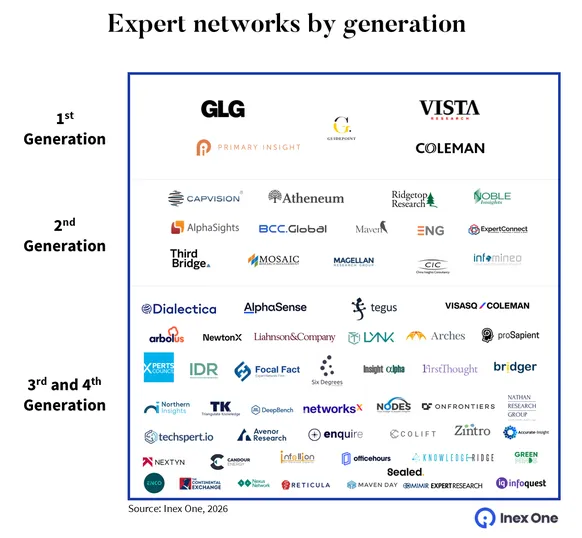
Japan’s VisasQ acquired U.S.-based Coleman Research for US$102 million to strengthen its global reach and unify compliance standards across markets. U.S. and European players like NewtonX have also drawn major funding rounds, showing how the industry is being recognized not as a niche, but as the next generation of professional insight delivery.
By 2026, the global expert network market is projected to surpass US$4.86 billion as demand for real-time decision support accelerates across consulting and investment sectors (Business Research Insights, 2026).
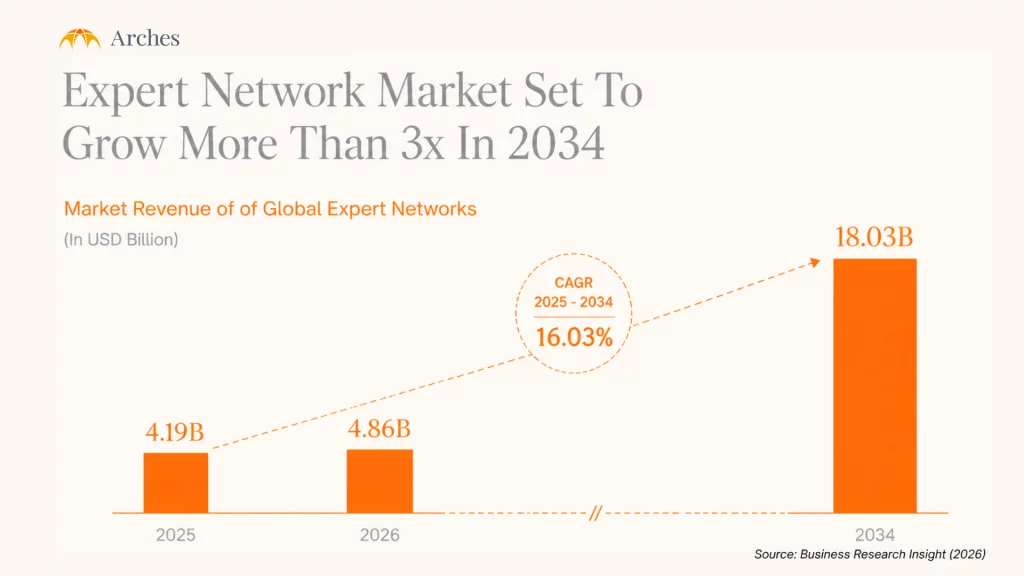
That growth reflects a broader shift in how organizations source insight, moving away from slow, report-heavy processes toward rapid validation from people actively working inside markets.
(Read about Arches Raises 410 Million Yen in Additional Funding)

“Our clients don’t pay for speed alone,” says Hiroki Kato, CEO of Arches. “They pay for direction. The right expert call gives decision-makers something no report can, that is, immediate clarity on what to do next.”
Expert Network Pricing Models Explained
Expert network pricing typically follows one of three models:
- Pay-as-you-go Model: Clients pay per expert consultation, usually hourly. Best suited for private equity, hedge funds, and consultants needing rapid validation.
- Subscription Model Clients commit to a minimum usage volume for discounted pricing. Often used by large consulting firms and corporates with recurring needs.
- Project-Based Model: Includes multiple expert calls, surveys, and research support under one scoped engagement.
Large global networks tend to operate at scale with fixed pricing tiers. Boutique or region-focused networks often apply flexible pricing based on geography and sourcing efficiency.
Pricing also varies depending on:
- Expert seniority
- Scarcity of expertise
- Geography
- Urgency
- Compliance complexity
The Ground View: Why Local Insight Matters
For global investors, especially those expanding across Asia, small context gaps can lead to large financial detours. A regulatory change in Vietnam, an unexpected market reaction in Korea, or a subtle difference in Japan’s corporate hierarchy, each can shift the feasibility of a deal.
Arches experts, who work inside these industries every day, often catch these shifts long before they appear in reports or data sets.
This is especially true in Asia, where many of the most valuable operators never appear in search results.
One global electronics firm entered China’s hydrogen sector, assuming even growth nationwide. Public data backed the optimism. Yet Arches energy experts painted a sharper map, subsidies pooled in only a few provinces, local standards still uneven, and pilot projects concentrated along the coast. A small shift in focus saved the client from nearly $20 million in misplaced investment and months of recalibration.
Find more cases at: Arches’s case study.
Whether it’s avoiding delay or correcting distortion, these insights show the value of context that only on-the-ground expertise can deliver. By flagging the issue early, the investor restructured the deal toward a different province with available grid capacity to save both time and capital.
Beyond Cost: A New Model for Trust and Precision
While large consulting firms still dominate traditional advisory, their scale often limits speed.
Expert networks are rewriting that model, decentralizing knowledge, and making specialized insight accessible to teams of any size.
And Arches takes that one step further. We follow the same compliance standards as global networks but pair them with local fluency, experts who understand not just what happens in Asia, but why it happens differently.
Because in this region, where informal networks and rapid shifts define markets, context is a competitive advantage.
Also, Arches details how this evolution extends beyond Asia to the U.S., which examines how highly specialized operators are sourced across the Americas and other global markets.
ROI of Using an Expert Network
Beyond how much it costs, the key question when evaluating an expert network becomes: “What ROI can this investment deliver?” The answer often comes down to a few measurable business outcomes.
| ROI Driver | Business Impact |
| Shorten decision timelines | Move from weeks of desk research to targeted conversations in days, helping teams act faster when opportunities arise. |
| Access first-hand market insight | Gain perspectives from experienced practitioners that are difficult to obtain through reports, public data, or internal research alone. |
| Protect multi-million-dollar investments | Identify commercial, operational, or regulatory risks before committing capital, helping organizations avoid costly investments in the wrong markets, projects, or partners. |
At Arches, this ROI is amplified by our custom-recruitment model, delivering highly relevant experts faster and at a more competitive cost.
How Arches Keeps Expert Network Cost Competitive
In a world where markets shift faster than planning cycles, accessing verified expertise isn’t a premium, but how strategic organizations stay accurate and ahead.
At Arches, the model is built for precision and efficiency. Our centralized teams in Vietnam and Colombia, rather than New York or London, allow the same high-caliber experts to be delivered often 20% more cost-efficient than global networks, without a tradeoff in matching quality.
Clients get equal (and often deeper) expertise in niche Asian markets, with faster turnaround and lower overhead.
| Factor | Global Expert Networks | Arches |
| Pricing | Premium | ~20% more cost-efficient |
| Asia sourcing | Global database | Local recruiting teams |
| Turnaround | Standard | Faster in Asia |
| Niche experts | Depends | Strong regional coverage |
| Compliance | Yes | Yes |
FAQs
Q1. How do major expert networks like GLG, AlphaSights, NewtonX, and Arches structure their pricing?
Most major expert networks price based on expert seniority, scarcity, geography, and urgency. Arches follows similar global standards but applies a region-focused model in Asia, allowing efficient access to both large expert pools and hard-to-reach niche markets.
Q2. With its cost-effective pricing, is Arches’ service still high quality?
Yes. Arches operates a network of more than 200,000 experts. It is also supported by a dedicated team of over 250 employees. This scale helps ensure that competitive pricing is paired with reliable access to relevant experts across markets, even niche ones.
→ Start a conversation with Arches
- Follow Arches on LinkedIn to get the latest updates from us.
- Subscribe to Arches’ monthly newsletter for grounded perspectives from experts across Asia and beyond, where global decisions meet local insights.
