
2026 Trends in TMT and the Rise of Expert Research
For Clients
The TMT (Technology, Media, and Telecommunications) sector is changing quickly in 2026. From infrastructure growth to AI adoption and evolving business models, companies are navigating a more complex market landscape.
As these shifts become harder to track through public data alone, expert networks are playing a bigger role in TMT research. They help businesses validate insights, understand niche markets, and make more informed decisions.
Here are three key TMT trends shaping 2026.
TMT Market Outlook
Market overview
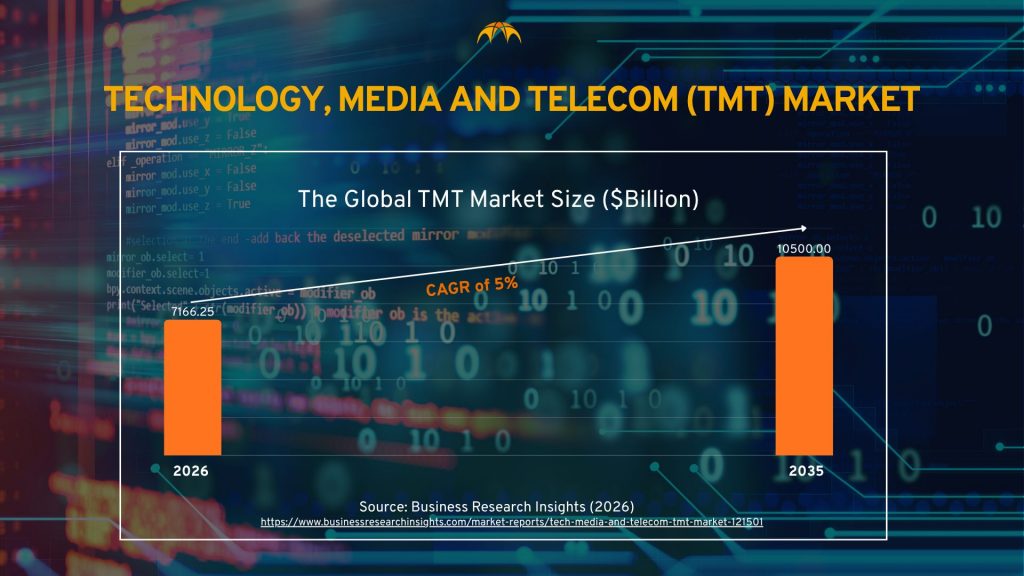
Global spending across the Tech, Media, and Telecom (TMT) ecosystem is expected to remain on an upward trajectory, with the market projected to grow from USD 7.17 trillion in 2026 to USD 10.5 trillion by 2035.
This reflects a 5% CAGR, driven by digital transformation, connectivity expansion, and increasing enterprise reliance on technology-enabled solutions (Business Research Insights, 2026).
Key players shaping the TMT trends
The Tech, Media, and Telecom (TMT) industry spans digital infrastructure, software, media, and communication services, with increasing overlap across these segments as technology ecosystems continue to evolve (Investopedia, 2025). Media and OTT platforms such as Amazon, Netflix, Disney, and Hulu reflect this convergence by combining streaming, digital content, and platform-based services.
Meanwhile, companies including Ethereum Foundation, Intel, BMW, BioNTech, and BeReal continue to drive innovation across the TMT landscape through advancements in AI, blockchain, 5G, and digital infrastructure, helping shape the sector’s long-term development (Business Research Insights, 2026)
Top 3 key trends in TMT Market 2026
AI is moving from hype to scalable integration
In 2026, AI in TMT is becoming less about hype and more about scale. The focus is shifting toward making AI easier to integrate, deploy, and use across existing digital ecosystems (Deloitte, 2026).
This is becoming visible through:
- AI built into existing platforms, such as search and SaaS:
Data from (Deloitte, 2026) showed that AI use within search could be 3x more common than standalone AI tools, reshaping how people discover information.
- Rising demand for AI infrastructure, especially compute and data centers
- Growth of agentic and physical AI, from automation to robotics: By 2026, nearly two-thirds of enterprises are investing or plan to invest in Agentic AI, while the global installed base of industrial robots continues to reach 5.5 million, signaling stronger adoption across both autonomous and physical AI systems
Infrastructure becomes a key growth battleground
As sovereign AI becomes a practical operating model, competition in TMT is shifting beyond software toward control of physical infrastructure. Access to compute, data, energy, and trusted networks is becoming increasingly important as organizations respond to security, privacy, and localization pressures (EY, 2026).
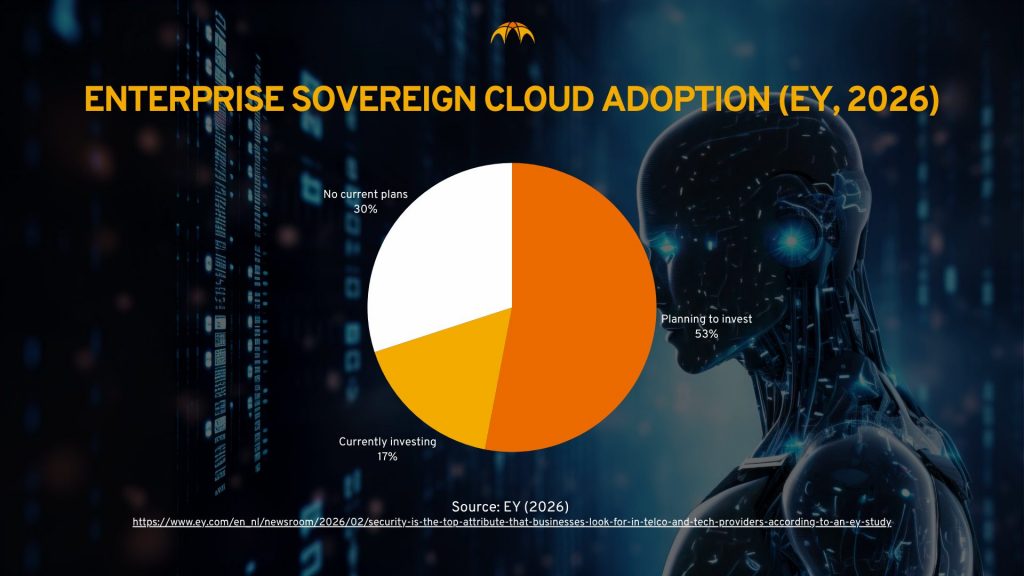
Rising sovereign cloud adoption reflects this shift, with 70% of organizations either investing in or planning adoption, driven primarily by stronger needs for cybersecurity, data control (EY, 2026).
This trend is specifically reflected through:
- AI competition moving toward physical assets, including data centers, power, and chips
- Greater localization of data and infrastructure to meet national and regulatory requirements
- Trusted domestic ecosystems gaining importance across cloud, telecom, and supply chains
The trend of platformization: from fragmented tools to connected digital systems
As technology markets become more competitive and customer expectations continue to rise, TMT companies are shifting away from standalone solutions toward more connected digital ecosystems. Value is increasingly created through how services, data, and applications work together rather than operate separately (Simon-Kucher, 2026).
This trend is taking shape through:
- Software and services being bundled into broader platform ecosystems instead of sold individually
- Data flowing across products and services to create more connected user experiences
- Platforms becoming the main structure for delivering and scaling digital products and services
The Rising Role of Expert Networks in TMT Research
Why desk research alone is no longer enough in TMT
TMT markets are becoming harder to track through desk research alone. Geopolitical tensions, disrupted supply chains, and tighter trade restrictions make 80% of technology and telecommunications companies feel they are facing increased risks (KPMG, 2026).
Research gaps are becoming more visible:
- Reports can quickly become outdated in fast-moving markets
- Public data often misses operational realities behind the numbers
For a deeper look at how desk research cannot keep up with this fast-changing world, see this overview
How expert networks are helping TMT research go deeper
Expert networks are helping research teams move beyond surface-level data into sharper, decision-ready insights.
They can add value by providing:
- Direct perspectives from operators and niche specialists
- Faster validation for assumptions and market signals
- Deeper context in complex or fast-evolving sectors
Explore how expert-led research supports stronger market understanding in this overview
FAQs
What are the best expert networks for TMT research?
Choosing the right expert network company depends on expertise depth, compliance standards, and cost efficiency. Arches is valued for balancing global research standards with flexible support and practical pricing across complex projects.
What types of experts can support TMT research?
Depending on the project, this may include operators, former executives, technical specialists, or functional experts with direct market experience.
As TMT markets become more complex and fast-moving, stronger research often depends on combining market data with real-world expert insight. With a team of 15+ nationalities, Arches supports global research needs with local understanding and flexible expert recruitment tailored to each project.
What we bring to every engagement:
- 24/7 support across global markets
- Dedicated support for global projects of all sizes
- Custom expert recruitment based on specific research needs
→ Start a conversation with us
- Follow Arches on LinkedIn to get the latest updates from us.
- Subscribe to Arches’ monthly newsletter for grounded perspectives from experts across Asia and beyond, where global decisions meet local insights.
