
What the Middle East War Is Already Costing Vietnam
Industry Insights
- Hoang Le – Consulting Manager (Vietnam / APAC), Arches Corporation
- Olivia Tran – Management Consulting Associate, Arches Corporation
- Hoa Nguyen – Media Relations Specialist, Arches Corporation
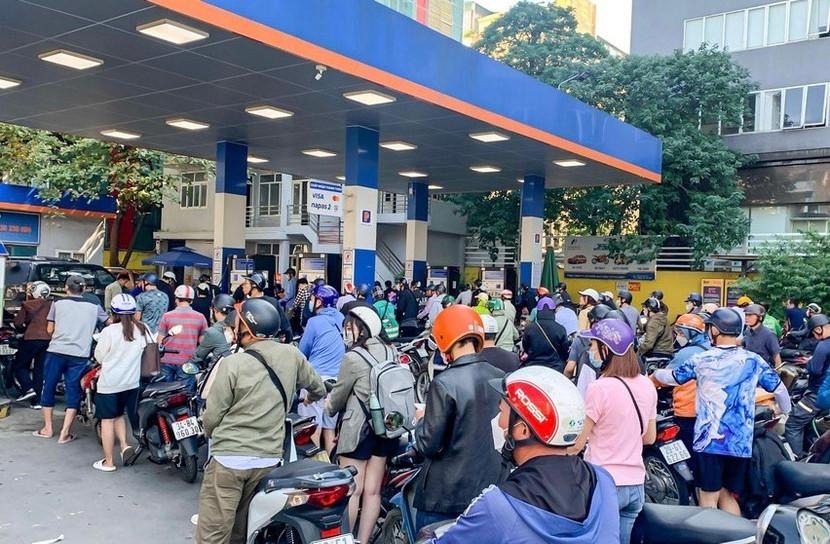
In recent days, the escalating conflict between the US, Israel, and Iran has drawn global attention. The fallout extends beyond the battlefield, and rising tensions are already disrupting oil markets, shipping routes, and trade flows worldwide. For Vietnam, the consequences are neither distant nor theoretical. The petrol queue on 7 March was just the first visible sign. The deeper impacts on energy security, supply chains, and trade routes are still unfolding.
A. Direct effects on bilateral trading between Vietnam and Middle East countries
The recent official signing of several agreements (such as VIFTA with Israel on 23/07/2023 and CEPA with the UAE on 28/10/2024) shows Vietnam’s vision and effort in establishing strategic partnerships with the Middle East nations. However, the parties have just kicked off the past 2-3 years, and the current total scale of trading between Vietnam and those countries still remains modest.
Figure 1: Vietnam Export / Import with the Middle East and other nations
(Unit: million USD)
| Timeframe | Total the world | Total Middle East* | Kuwait | Israel | Saudi Arabia | UAE | Turkey | |
| 2023 Export | Value | 354,671 | 8,527 | 70 | 631 | 1,131 | 4,015 | 1,769 |
| Percent | 100% | 2.40% | 0.02% | 0.18% | 0.32% | 1.13% | 0.50% | |
| 2023 Import | Value | 326,374 | 11,027 | 5,882 | 2,053 | 1,552 | 677 | 469 |
| Percent | 100% | 3.38% | 1.80% | 0.63% | 0.48% | 0.21% | 0.14% | |
| 2024 Export | Value | 405,531 | 10,999 | 71 | 795 | 1,611 | 5,621 | 1,930 |
| Percent | 100% | 2.71% | 0.02% | 0.20% | 0.40% | 1.39% | 0.48% | |
| 2024 Import | Value | 380,764 | 13,154 | 7,250 | 2,452 | 1,464 | 851 | 443 |
| Percent | 100% | 3.45% | 1.90% | 0.64% | 0.38% | 0.22% | 0.12% | |
| 2025/11M Export | Value | 430,175 | n/a | 80 | 783 | 1,913 | 5,382 | 1,637 |
| Percent | 100% | 0.02% | 0.18% | 0.44% | 1.25% | 0.38% | ||
| 2025/11M Import | Value | 409,607 | n/a | 5,798 | 2,555 | 1,109 | 527 | 404 |
| Percent | 100% | 1.42% | 0.62% | 0.27% | 0.13% | 0.10% | ||
*Except for Total Middle East data is quoted from ITC Trademap, whose 2025 data is not updated yet.
From customs data, despite an increase in the value, Vietnam’s trade with the Middle East only accounts for 3% – 4% of the national balance. Hence, the recent chaos may not be a big harm in the short term to our economy.
Having said that, looking deeper into Vietnam’s export/import partners and structures, some potential threats could be detected:
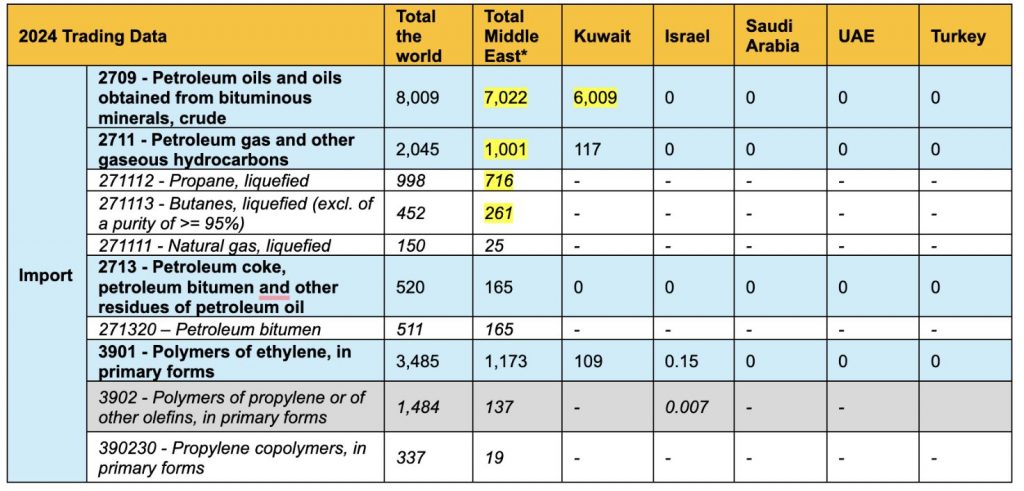
- About 85% of import value from Middle East to Vietnam is from fuels and oil (under HS code 27) and 10% from plastics (HS code 39), with some attributing to critically major sources for Vietnam, such as Crude Oil (nearly 90% of Vietnam import), Propane/Liquified (70%), Butanes/Liquified (60%), coming mainly from Kuwait. Electrical machinery/equipment is another big category, imported from Israel, the UAE, etc. However, its size is comparatively small in total Vietnam imports.
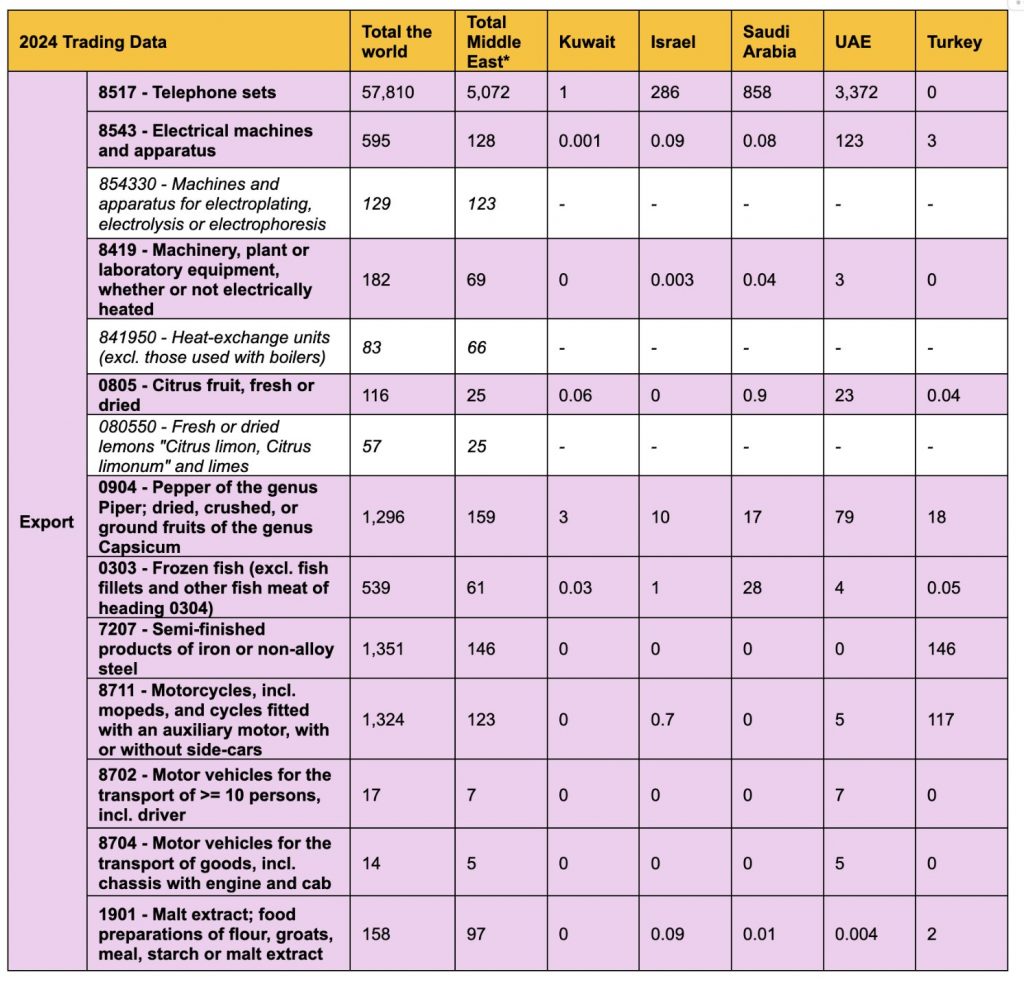
- Electrical machinery/equipment grasps the highest proportion in Vietnam’s export to the Middle East at nearly 60%; under which some categories, such as Machines and apparatus for electroplating, electrolysis or electrophoresis (854330) and Heat-exchange units (841950) range a majority of Vietnam’s total export, but those are niche and minor sectors. Agriculture and Fishery also gain traction; however, the scale is still very small. All in all, Vietnam’s exports will be less likely to suffer much pain due to the fights.
- Kuwait, Israel, Saudi Arabia, United Arab Emirates (UAE) and Turkey are the 5 most active partners (seizing approximately 90% of all the Middle East’s trading numbers with Vietnam). Amongst those, Israel and Kuwait contribute more considerably to imports into Vietnam. While being a big trade partners, the bad news is Israel is directly involved in the ongoing missile war fight, and the smoke has expanded tightly to Kuwait. Although Vietnam’s trading is not much reliant on Israel, the involvement of Kuwait in the war will lead to larger butterfly effects, which affect Vietnam’s crude oil sources.
Figure 2: Selective Top Export /Import Categories between Vietnam and Key Middle East Countries (picked up those with 10% or above in the total Vietnam trading balance).
(Unit: million USD)
Source: ITC Trade Map.
Crude oil is imported primarily to serve two big domestic refineries, Dung Quat and Nghi Son, for producing industrial and commercial fuels. A scenario where our crude oil from Kuwait is shut down by war would present critical interruptions in the manufacturing and supply chain, resulting in many socio-economic consequences, such as rising energy prices, up-to-ceiling CPI and inflation, etc. To trigger timely counter-measures, Vietnam Government is pushing enterprises to accelerate contracting with alternative partners (from South-East Asia, Australia, US) and strictly maintain the required provisions to be ready for tightening supply situations.
B. What else are more intimidating threats to Vietnam economy?
As studied above, US-Iran-Israel conflicts may pose more consequential risks to Vietnam at multiple angles. Crude oil shortage with potential instabilities followed are just one most visible future outcome, while the current reflex reactions from the other nations may create bigger spreading waves.
Larger consequential influences from the rest of the world
(1) A large proportion of cargo shipments from Vietnam to the EU, Africa, and East America goes through the Suez Canal and Strait of Hormuz. Jebel Ali Port is one central hub where Vietnam’s goods are distributed to the Persian Gulf and Central Asia. In other words, the Middle East is an important gateway connecting Vietnam and international partners.
In the escalating tensions, across multiple countries all over the world, numerous sea freight (namely Maersk, MSC, CMA CGM, Hapag-Lloyd, Ocean Alliance, NYK Line, MOL etc.) and air transportation companies (e.g. Lufthansa Group, Emirates & Qatar Airways, Turkish Airlines & Air France-KLM, British Airways & Finnair, and even Vietnam Airlines) have been cancelling or re-routing to avoid the territories under dispute. These result in delays in cargo delivery and human travel, increases in operational and logistics expenses, insurance fees and shipping prices.
The subsequent effect could be the shrinking of global demands, as the buyer countries would choose nearer selling countries to avoid broken supplies and paying more for transportation. Lagging time also creates more trouble preserving fresh or frozen products such as fruits, vegetables, meat and fish.
(2) As the retaliations continue and the world reacts protectively, surging prices are inevitable. Obviously, oil and gas show a drastic upward trend, rising by over 10%; meanwhile, the petroleum in Vietnam has risen significantly by ~35%. Economists assess that Vietnam is one of the most sensitive Asian countries to oil price fluctuations. Despite the presence of the Petrol Price Stabilization Fund, citizens and businesses will feel insecure, and many daily goods and services will be priced higher accordingly. At the same time, the US dollar’s acceleration isa factor that all export/import companies must pay attention to, as it closely determines their revenues and operating costs.
Figure 3: Pricing indices of several key commodities since the warfight started
| Categories | Global Market | Vietnam Domestic Market |
| Oil & Gas | Brent Oil: ~80 USD/bbl (02/03) → ~90+ USD/bbl (07/03). WTI Oil: ~74 USD/bbl (02/03) → ~81 USD/bbl (07/03). | RON 95-III Petrol: ~20,150 VND/l (02/03) → ~27,040 VND/l (07/03). E10 RON: ~19,820 VND/l (02/03) → ~25,850 VND/l (07/03). |
| Gold | Keeps swinging up-and-down unpredictably. It might be the will to take profit after a long hot growing period combined with the fear of war, but precious metals will remain a desired value-preservation tool in long term. | |
| USD Exchange Rate | DXY fluctuates but seems to move upward. | State Bank of Vietnam (08/03): USD/VND 25,057, marking a consecutive 7-day increase of 13 VND. |
From fear to Potential disruptions
From our analysis, the conflict in the Middle East may not be affecting Vietnam directly, but its ripple effects are already being felt across multiple levels, from the global landscape to the domestic market and even everyday life.
(1) Civilian sentiment is shaken to some extent. Shortly after the news about the petrol price adjustment, people rushed to have their vehicles refilled. Long lines were seen outside gas stations. The shadow may spread as people are very much concerned that all goods and services will become expensive. As a defense mechanism, consumers will buy less, buyers will raise their prices, making it an endless loop.
(2) At the same time, the private sector is being more cautious. They all have clearer reasons to slow down international activities, especially those involved with the Middle East. The skepticism can also be costly, as companies downsize the business or find a replacement for the current partners/routes. Eventually, it results in a stagnant supply chain.
If unsettled war fights keep lasting and extend to other territories
This is not an expected scenario, but not entirely impossible. If the fight intensifies, every bad outcome seen so far will be multiplied. In recent years, sudden, global-scale instabilities have become more frequent and harder to predict. To build resilience against similar shocks, Vietnam needs to accelerate the completion of a robust, streamlined supply chain, one that can withstand external disruptions without breaking down. At the same time, expanding into new markets and establishing partnerships with a more diverse range of countries remains the clearest strategy to reduce dangerous over-reliance on any single source. That must be the directional focus for Vietnam in the coming phase
As a global firm with profound experiences exploring and setting footprints in new countries, Arches recommends that both the Vietnamese government and businesses prepare early by:
- Preparing sufficient provisions and quick action plans for different scenarios.
- Proactively discuss and negotiate with other partners to find alternative resources.
- Timely tracking of the movements of every party, setting a mental-state ready for all of the domestic entities, from regular citizens to the business sector.
About Arches Expert Solution
Looking for deeper market intelligence?
At Arches, we help corporate and consulting teams go beyond surface-level research. Our Expert Solution combines structured market frameworks with targeted expert validation, giving teams the clarity they need before committing to a new market.
Learn more about Expert Solution →
To discuss how Expert Solution is typically applied in real market entry decisions, meet Hoang Le, our Expert Solution | Consulting Manager, who works closely with corporate and consulting teams on early-stage market assessments across the region.

Follow Arches on LinkedIn to get the latest updates from us.
Subscribe to Arches’ monthly newsletter for grounded perspectives from experts across Asia and beyond, where global decisions meet local insights.
