
Qualitative Research Methods for Strategic Decisions
For Clients

Strategic decisions rarely fail because of a lack of data. They fail because critical assumptions remain untested.
Market reports can estimate demand, competition, and industry growth. They rarely explain why customers behave as they do, how operators respond to changing conditions, or where execution risks emerge.
Qualitative research methods help close this gap. Through interviews, observation, and field research, they provide firsthand insight that helps investment and strategy teams validate assumptions before making high-impact decisions.
According to Qualtrics, qualitative research helps organizations understand people’s behaviors, attitudes, experiences, and motivations, making it particularly valuable when context matters as much as measurement.
For private equity firms, consulting teams, and corporate strategists, choosing the right qualitative research method can significantly improve decision quality.
Why Qualitative Research Methods Matter for Business Decisions
Different business questions require different types of evidence.
A commercial due diligence project may focus on competitive positioning and customer purchasing behavior. A market entry assessment may require insight into regulatory implementation, distribution channels, or local operating practices. A product strategy project may seek to uncover unmet customer needs before investing in development.
Although these projects have different objectives, they share a common challenge: understanding factors that secondary research cannot fully explain.
Qualitative research methods provide that context by revealing why markets behave the way they do and how participants respond to changing conditions.
McKinsey’s State of Organizations 2025 highlights that organizations make stronger decisions when they incorporate multiple sources of information and diverse perspectives rather than relying on a single input. For investment and strategy teams, this reduces the risk of making decisions based on incomplete assumptions.
Key Insight
The value of qualitative research methods lies in matching the research approach to the business question.
Choosing the Right Qualitative Research Methods
Every qualitative research method provides a different perspective. The right choice depends on the business question rather than the method itself.
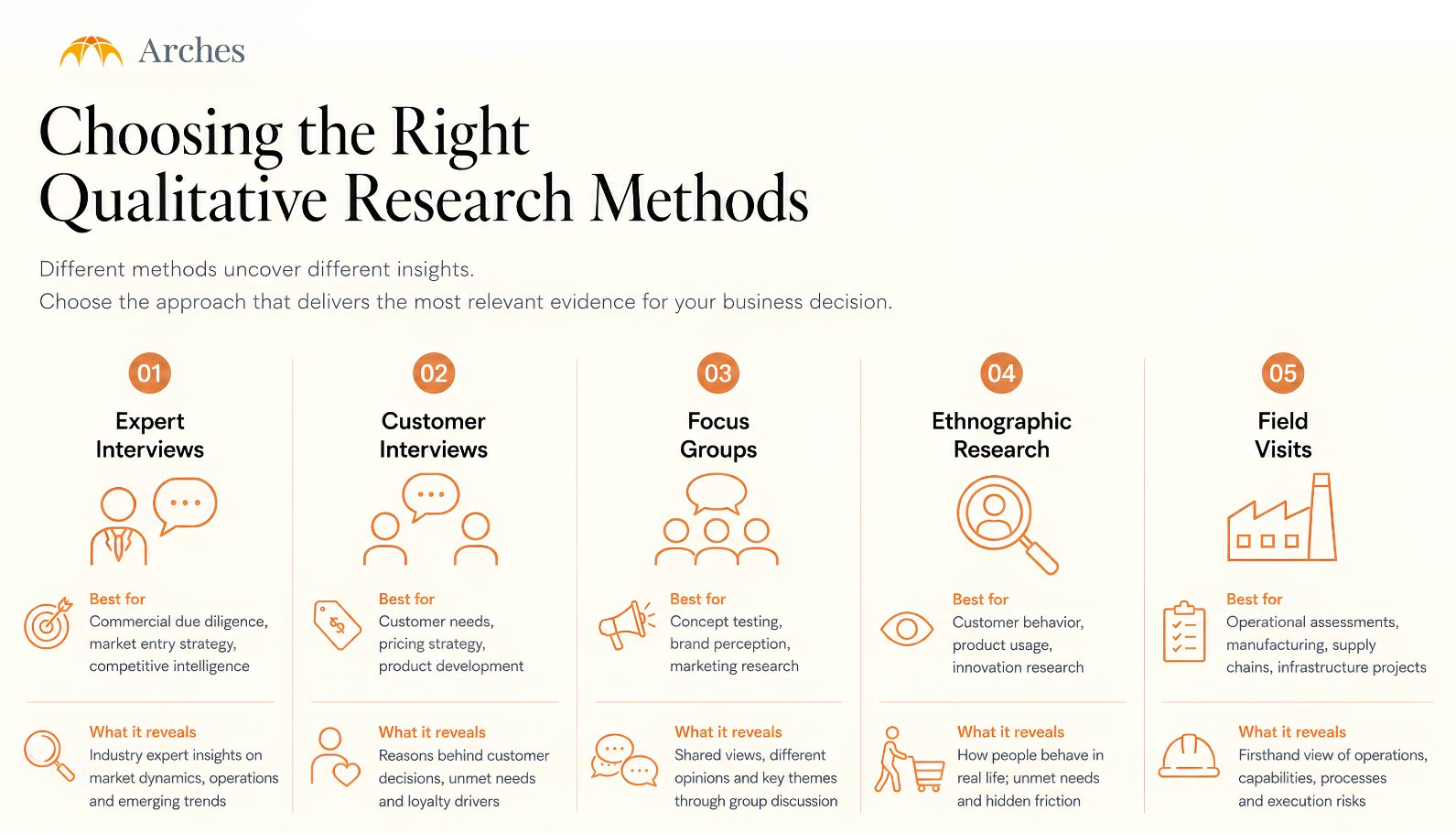
Expert Interviews
Best for: Commercial due diligence, market entry strategy, competitive intelligence
Expert interviews connect researchers with experienced industry practitioners who can explain operational realities, competitive dynamics, and emerging market developments.
Because interviews allow researchers to ask follow-up questions and explore unexpected findings, they are particularly effective when testing investment assumptions or evaluating complex markets under tight timelines.
→ Explore how expert interviews fit into a broader primary research strategy.
Customer Interviews
Best for: Customer needs, pricing strategy, product development
Customer interviews reveal the motivations behind purchasing decisions, helping organizations refine pricing, positioning, and product strategy.
Focus Groups
Best for: Concept testing, brand perception, marketing research
Group discussions uncover shared perceptions, differing opinions, and emerging themes that individual interviews may not reveal.
Ethnographic Research
Best for: Customer behavior, product usage, innovation research
Observing customers in their natural environment helps identify unmet needs and operational friction that interviews alone may miss.
Field Visits
Best for: Operational assessments, manufacturing, supply chains, infrastructure projects
Firsthand observation provides context on operational performance, production capabilities, and execution risks that are difficult to assess through desk research.
→ Explore how field visits and expert validation fit into a broader market entry strategy.
Combining Qualitative Research Methods for Stronger Insights
Complex business decisions rarely rely on a single source of evidence.
Many consulting and investment teams combine qualitative research methods because each answers a different question. Expert interviews validate industry assumptions, customer interviews explain purchasing decisions, and field visits provide operational context. Together, these approaches create a more complete understanding of markets before strategic recommendations are made.
The Nielsen Norman Group recommends combining interviews with contextual inquiry and observation because each method reveals different aspects of user behavior and decision-making. Understanding what people say alongside what they actually do often produces richer business insights.
Key Insight
Combining qualitative research methods strengthens confidence by validating assumptions from multiple perspectives.
Qualitative Research Methods in Practice
The most effective qualitative research methods generate insights that directly influence business decisions.
A recent Arches project illustrates this approach. A global plastics company sought to understand why recycled plastic adoption remained limited in the home appliance industry. Public reports highlighted sustainability commitments but offered little explanation for the slow pace of adoption.
Through expert interviews with manufacturers and industry practitioners, the client uncovered technical, supply chain, and organizational barriers that refined its commercial strategy and revealed opportunities that were not visible through secondary research alone.
The project highlights a common challenge in strategic research. Market reports explain what is happening. Qualitative research methods explain why, helping teams validate assumptions before making investment or commercial decisions.
How Expert Networks Support Qualitative Research Methods
Some business questions require perspectives that are difficult to access through traditional recruitment. Expert networks connect consulting firms, private equity investors, and corporate strategy teams with experienced operators, executives, customers, and industry specialists who can validate critical assumptions.
Among qualitative research methods, expert interviews are particularly valuable for commercial due diligence, market entry, and strategic assessments because they provide firsthand insight into competitive dynamics, operational realities, and emerging risks.
→ Explore what you’re actually paying for when using an expert network.
How Arches Supports Qualitative Research
Arches supports consulting firms, investors, and corporate strategy teams through custom expert recruitment tailored to each project’s research objectives.
With access to specialists across industries and global markets, plus a team spanning 15+ nationalities, Arches supports cross-border due diligence, market entry, and strategic research across North America, EMEA, LATAM, and APAC.
→ See how PE firms and consulting teams evaluate the right expert network partner.
→ Contact Arches to connect with the right experts for your next qualitative research project.
FAQ
What are qualitative research methods?
Qualitative research methods collect non-numerical information to understand behaviors, motivations, experiences, and decision-making. Common methods include expert interviews, customer interviews, focus groups, ethnographic research, and field visits.
Which qualitative research method is best for commercial due diligence?
Expert interviews are widely used because they provide firsthand perspectives from experienced practitioners. They help validate investment assumptions, assess competitive dynamics, and identify operational risks before strategic decisions are made.
→ Start a conversation with us
Follow Arches on LinkedIn for live updates.
Subscribe to the Arches’ newsletter for monthly insights from our network across Asia and beyond.
