
Transportation Infrastructure Trends in Asia for Investors
For Clients
Transportation infrastructure is a dominant global investment theme. While U.S. capital targets EV and logistics networks, Asia presents the most compelling growth opportunities, fueled by state investment, supply chain diversification, and rapid urbanization.
With the OECD projecting that global infrastructure needs will surpass $90 trillion by 2040, private equity’s core mandate is to identify assets capable of converting this macro expansion into sustainable returns.
Why Transportation Infrastructure Is Becoming A Strategic Investment Theme
Several long-term trends are increasing investor interest in transportation infrastructure across Asia.
EV Infrastructure Is Becoming A Strategic Asset
Most discussions around EV trends focus on vehicle manufacturers. However, investors are increasingly focusing on the infrastructure supporting electrification.
According to the International Energy Agency (IEA), global EV sales exceeded 17 million units in 2024. Public charging infrastructure surpassed 5 million charging points globally, with more than 1.3 million added during the year.
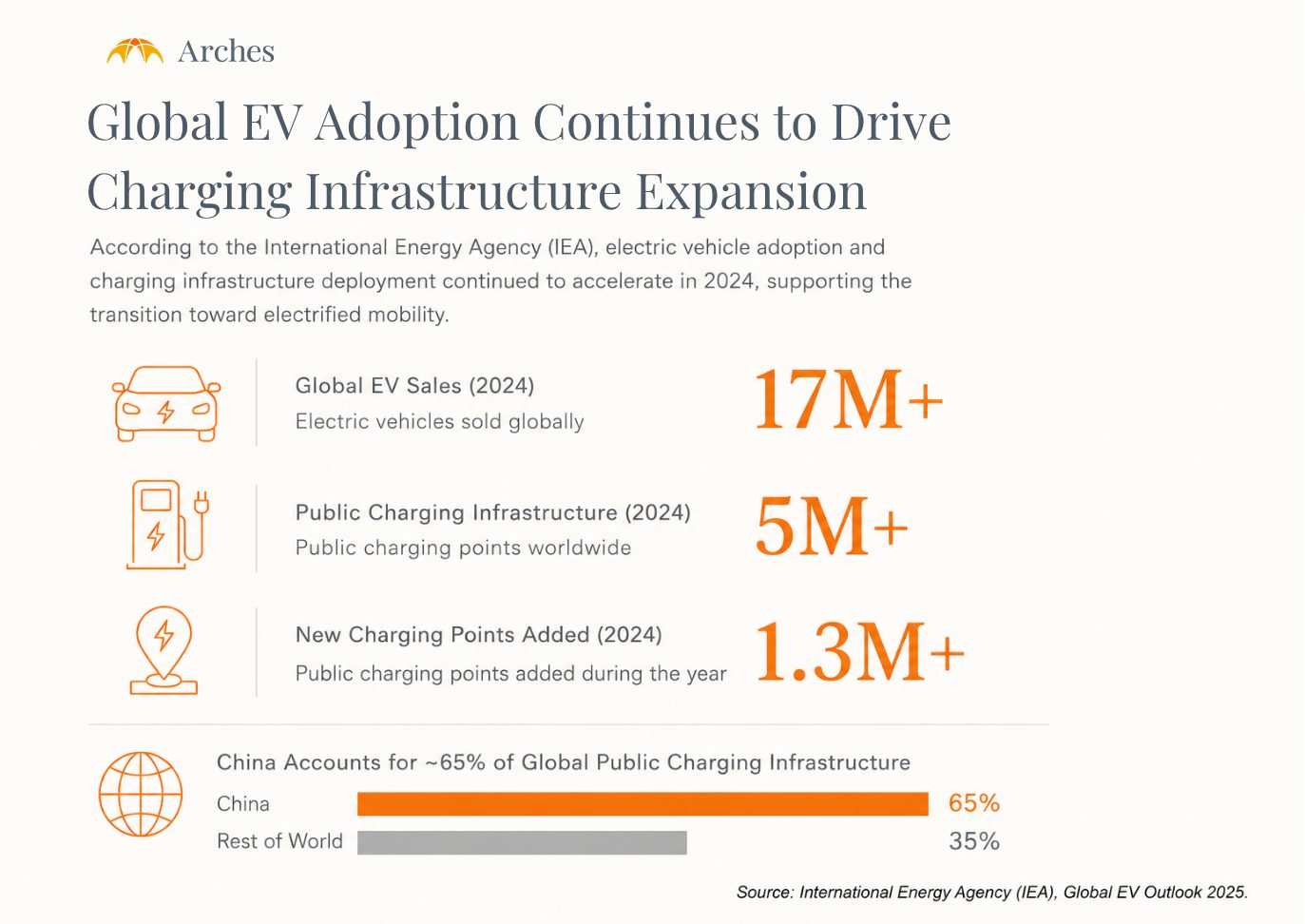
Asia remains central to this growth. China operates the world’s largest charging network, while India, Indonesia, Thailand, and Vietnam continue expanding their EV ecosystems.
As EV adoption grows, charging networks, grid infrastructure, and energy management systems are becoming critical parts of the transportation ecosystem.
What This Means For Investors
The investment opportunity increasingly extends beyond EV manufacturers.
- Charging infrastructure can benefit regardless of which automaker gains market share.
- Fleet charging and grid modernization may see rising demand as commercial electrification accelerates.
- Infrastructure assets often provide exposure to long-term EV adoption without relying on a single vehicle brand.
For investors evaluating transportation infrastructure in Asia, the key question is increasingly which assets enable electrification at scale.
Logistics Infrastructure Is Being Rebuilt For Resilience
Supply chains have changed significantly since the pandemic.
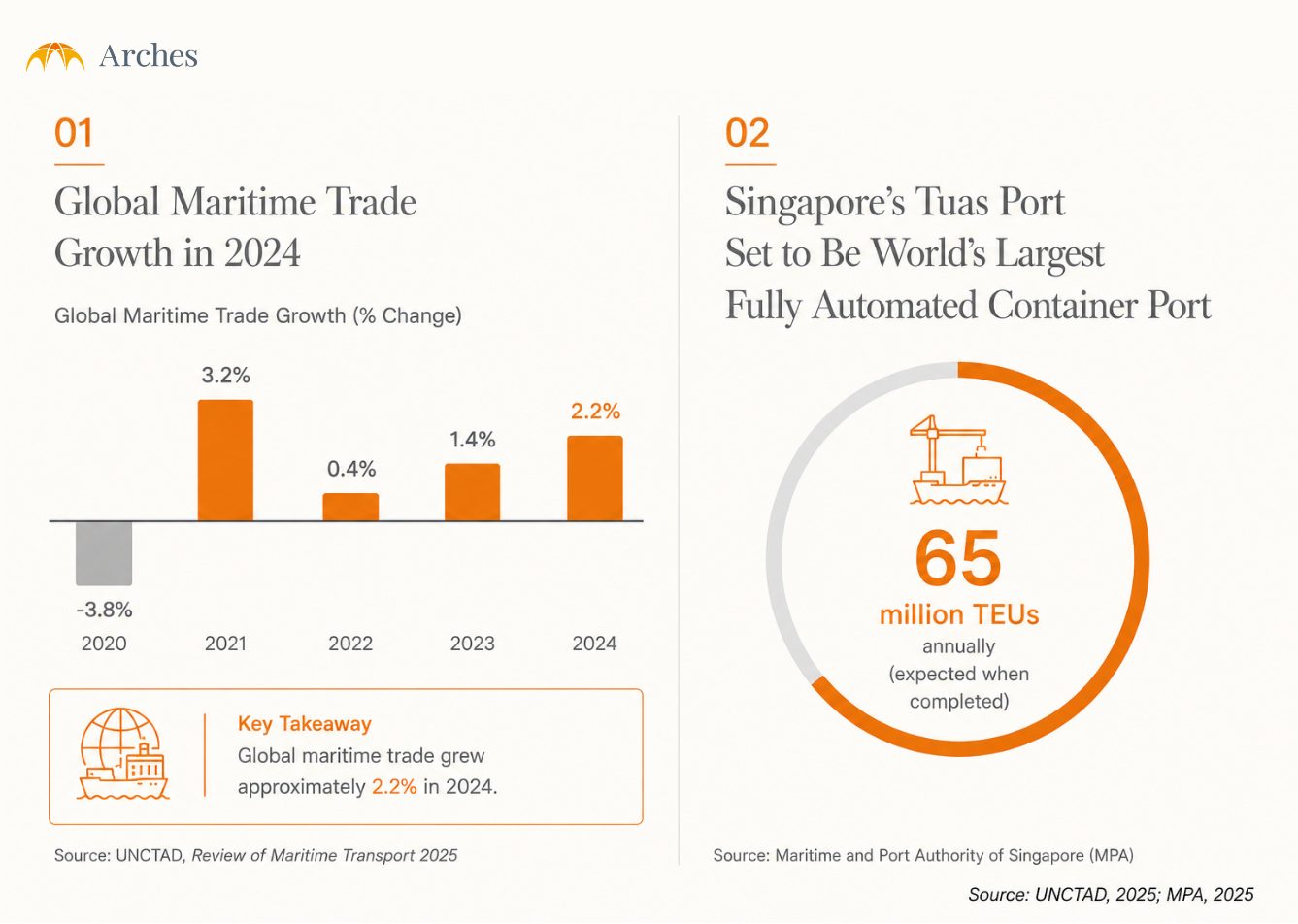
According to UNCTAD’s Review of Maritime Transport 2025, global maritime trade grew approximately 2.2% in 2024, while geopolitical tensions and supply chain diversification continue to reshape trade routes.
Asia remains at the center of this shift. Singapore’s Tuas Port is expected to handle up to 65 million TEUs annually when completed, making it the world’s largest fully automated container port.
“Investing in resilient infrastructure is not a trade-off against financial returns: it is a pathway to them. It ensures continuity of essential infrastructure services, protects jobs, and unlocks long-term growth”
— Nicolas Peltier-Thiberge, Infrastructure Director for Strategy & Operations, World Bank Group
What This Means For Investors
Transportation infrastructure is increasingly being designed for resilience, flexibility, and digital integration rather than throughput alone.
Investors are paying closer attention to:
- Ports positioned along emerging trade corridors.
- Logistics hubs supporting supply chain diversification.
- Infrastructure assets that leverage automation and digital technologies.
- Facilities that can adapt to shifting trade flows and regulatory changes.
As supply chains become more regionalized, transportation infrastructure is increasingly viewed as a strategic asset rather than simply an operational necessity.
Mobility Infrastructure Is Expanding Beyond Traditional Transit
Transportation infrastructure now extends beyond roads, railways, and airports. Investors are increasingly evaluating:
- EV charging ecosystems
- Smart mobility systems
- Urban transit technologies
- Digital transportation platforms
- Integrated transportation networks
Governments across Asia continue investing heavily in these areas. India’s National Infrastructure Pipeline and China’s continued high-speed rail expansion illustrate how mobility infrastructure is becoming an ecosystem investment that combines transportation, energy, technology, and regulation.
These trends create attractive opportunities.
However, market growth alone does not determine investment outcomes.
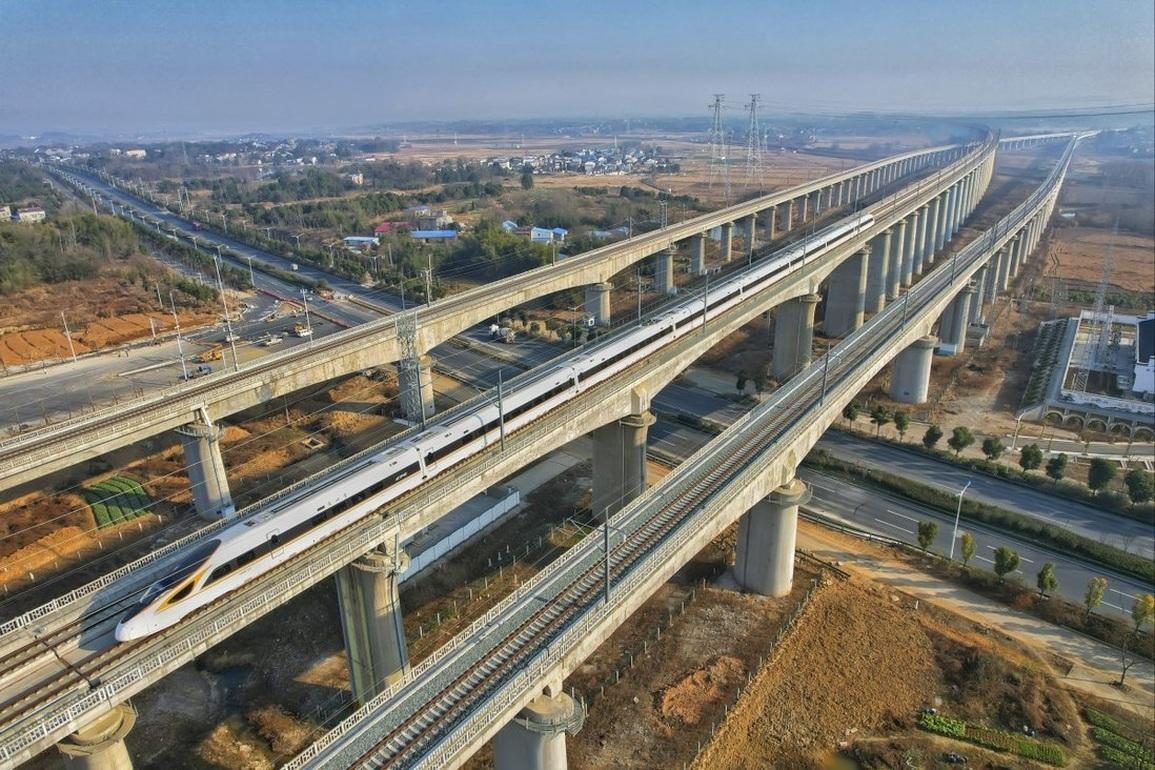
China wants to expand its high-speed rail network to 50,000 km
(Source: Xinhua News Agency).
Transportation Infrastructure Due Diligence In Practice
Across transportation infrastructure investments, investors often face the same challenge:
Market forecasts can estimate demand. They are far less effective at explaining how that demand translates into asset-level performance.
Evaluating EV Charging Infrastructure
The EV market is growing rapidly. The harder question is whether a specific charging asset can generate attractive returns.
McKinsey’s research highlights that charger utilization remains one of the most important drivers of charging infrastructure profitability, yet utilization can vary significantly across locations.
Public data can show:
- EV adoption growth
- Government charging targets
- Infrastructure investment plans
However, investors still need to validate:
- Utilization rates
- Grid reliability
- Permitting timelines
- Fleet adoption plans
- Competitive charging density
Two charging stations in the same city may produce very different economics. This is where conversations with charging operators, utility companies, fleet managers, and infrastructure developers can provide valuable context.
Assessing Logistics Infrastructure Opportunities
Strong trade growth does not eliminate operational risk. According to Prologis research, logistics asset performance is often influenced by local supply conditions, customer retention, and location quality rather than macro growth alone.
Public data can show:
- Trade forecasts
- Cargo volumes
- Manufacturing expansion
However, investors often need to validate:
- Customer concentration
- Tenant retention risks
- Labor availability
- Congestion bottlenecks
- Competitive expansion nearby
A logistics hub may benefit from favorable market conditions while still facing local challenges that reduce long-term returns. Conversations with operators, freight forwarders, and major customers can often reveal risks that are difficult to identify through secondary research.
The Gap Between Market Growth And Asset Performance
A common pattern appears across transportation infrastructure investments.
Market reports are effective at estimating industry growth. They are less effective at explaining how that growth translates into asset-level performance.
Bain notes that successful commercial due diligence focuses not only on market attractiveness but also on whether a specific asset can outperform within that market.
An industry may expand rapidly while individual assets underperform due to low utilization, regulatory delays, infrastructure bottlenecks, or slower-than-expected adoption.
Why This Matters For Investors
Strong industry growth does not guarantee strong asset returns.
Across Asian transportation infrastructure markets, performance is often influenced by local factors such as utilization, permitting, customer concentration, and infrastructure readiness.
These variables can differ significantly even between assets operating within the same market. As a result, many investors supplement market forecasts with operator interviews and local expert perspectives to test assumptions before capital is deployed.
The objective is to identify which assets are positioned to capture it.
Why Transportation Infrastructure Requires Local Expertise
Transportation infrastructure projects are often shaped by factors that rarely appear in public reports:
- Local regulatory interpretation
- Infrastructure bottlenecks
- Supplier ecosystems
- Operator behavior
- Technology adoption patterns
These factors frequently determine investment outcomes.
As a result, many investors complement desk research with direct conversations with operators, regulators, infrastructure developers, and industry specialists to validate assumptions before making investment decisions.
How Arches Supports Transportation Infrastructure Research
Transportation infrastructure investments increasingly require expertise across mobility infrastructure, logistics, energy, regulation, and supply chains.
Arches supports transportation infrastructure due diligence through custom expert recruitment tailored to each project’s specific investment questions.
With access to experts across Asia and a team spanning 15+ nationalities, Arches helps investors validate assumptions, understand local market dynamics, and uncover risks that may not be visible through secondary research alone.
→ Request a demo to explore transportation infrastructure expertise
Frequently Asked Questions
What is transportation infrastructure?
Transportation infrastructure refers to the physical and digital systems that enable the movement of people and goods, including roads, railways, ports, airports, EV charging networks, logistics hubs, and smart mobility systems.
Why are investors interested in transportation infrastructure in 2026?
Several transportation infrastructure trends are attracting investors, including electrification, supply chain diversification, government infrastructure spending, and the growth of digital mobility platforms. Together, these trends are creating long-term investment opportunities across Asia and global markets.
Follow Arches on LinkedIn for live updates.
Subscribe to the Arches’ newsletter for monthly insights from our network across Asia and beyond.
