
How the Vietnam International Financial Centre (IFC) Brings Infrastructure Investment Opportunities
Industry Insights
The Vietnam International Financial Centre (VIFC) created the conditions under which Vietnam’s infrastructure investment can finally be financed at the scale the country needs, which was not possible before.
Vietnam’s transport master plan targets $43-65B in investment between 2021 and 2030, with nearly $14B earmarked for seaport development alone. However, the state budget covers less than half of that, which means the plan requires private capital to exist.
What we lacked to attract this capital was the structure to protect the investors; consequently, capital looked at the same assets and passed since the architecture to access and protect a long-horizon bet simply was missing.
For most of the past decade, that left a well-documented infrastructure gap with no viable financing path to close it. VIFC changes that. And the institutions that understand exactly how are already moving.
Why the International Financial Centre Changes the Equation
The Vietnam IFC was launched on February 11, 2026, under Resolution 222/2025/QH15. It operates as a separate regulatory zone inside Vietnam. The framework is built around international financial standards while sitting alongside Vietnam’s existing legal system.
The structure mainly targets institutions moving long-term capital into Vietnam. That includes firms handling deal origination, financing, asset refinancing, and product distribution.
For most manufacturers, contractors, and operating companies outside Ho Chi Minh City and Da Nang, daily operations still fall under standard Vietnamese law. Registering under the IFC changes little at the operational level.
The same applies to many institutional investors already using Singapore SPVs or offshore financing structures. Moving into the Vietnam IFC would likely depend on whether the structure creates a clear financing or execution advantage for specific transactions.
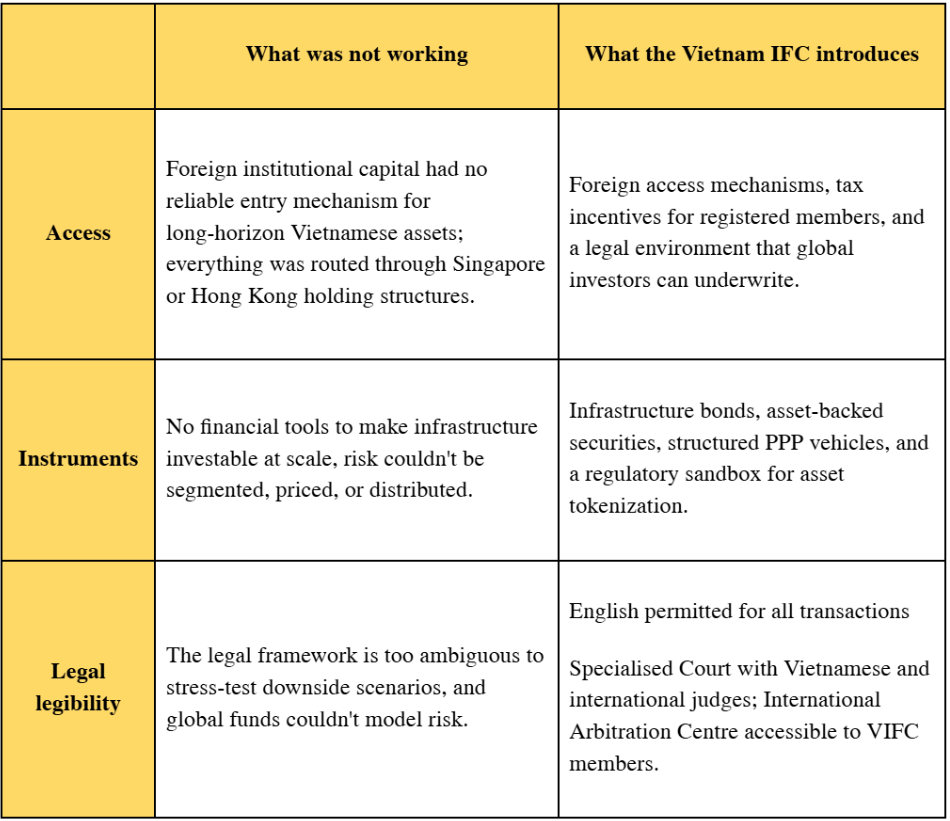
For those it serves, three structural problems are addressed:
And Financing Infrastructure Projects would be affected as follows under the Vietnam International Financial Centre:
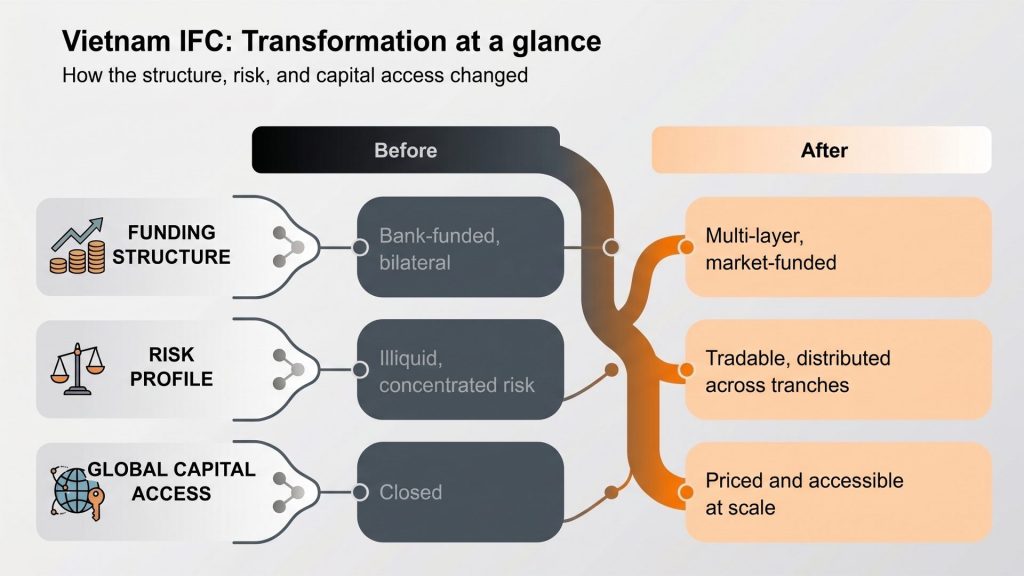
After years, Vietnamese infrastructure can finally move from state-funded projects accessible to a few domestic players to globally tradable financial assets that institutional capital can price, distribute, and manage.
Why Financial Institutions Win the Most from the International Financial Centre
Vietnam IFC restructures who earns from it, and at what points in the lifecycle.
Consider the traditional model of funding: Techcombank– one of Vietnam’s largest joint-stock banks- lends, for example, $1B to a developer to build a large-scale project. The project stalls. The bank is left holding a large, illiquid exposure: capital locked for years, recovery uncertain, risk concentrated entirely on one balance sheet.
Financial institutions in this model earn interest and bear the full downside when things go wrong. The IFC model spreads that exposure across different types of capital:
- Insurance funds, pension funds, and sovereign capital can take senior debt positions with lower risk and lower returns.
- Private credit and PE funds can take mezzanine layers with higher yields.
- Developers and growth equity investors take the equity tranche and absorb the highest risk.
Future project revenues can also be packaged into securities and sold earlier. That gives developers liquidity before a full exit.
- PPP structures split operational and regulatory exposure between the government and private operators.
- FX and interest rate risks move to counterparties through hedging contracts.
The role of financial institutions shifts accordingly. Banks still lend money, but the larger fee pool comes from arranging deals, structuring products, syndicating exposure, and refinancing assets later. Revenue no longer comes from a single loan held for decades. It comes from multiple touchpoints across the asset lifecycle:
- Origination: PPP structuring, arrangement fees
- Packaging: bonds, ABS issuance, structuring margins
- Distribution: LP placement, syndication spreads
- Recycling: refinancing cycles, asset management mandates
Infrastructure players remain capital-intensive, with payback periods measured in decades. Financial intermediaries operating under Vietnam IFC’s framework are asset-light, earning at every stage of the capital flow, other than just at the point of deployment.
Reading the Signals
Not every announcement around Vietnam’s IFC carries the same level of commitment. Some projects are already moving into execution. Others are still early-stage proposals discussed in investment and deal-making settings. That difference matters when assessing market timing.
What is already confirmed:
- Vietcombank and Nam A Bank have received shareholder approval to set up dedicated IFC subsidiaries. These are concrete organizational moves, not just discussions.
- Nasdaq is helping build the technical infrastructure needed for international-standard listings inside the zone.
- Warburg Pincus and Vantage Point have also announced a combined $10B capital commitment tied to the ecosystem. This shows that major global investors are already positioning early.
Other announced projects point to where the market may head next.
- The $6.1B Aviation Finance Hub announced at Singapore Airshow 2026 is Vietnam’s first dedicated aviation finance initiative.
- The proposed $10B maritime finance hub in Ho Chi Minh City is linked to Vietnam’s major port network.
These projects are important signals, but announced deals and deployed capital are not the same thing. Large figures often appear before projects fully close or move into execution.
Right now, the core infrastructure is starting to take shape. Capital deployment is still early. That means the entry window remains open, though it may not stay open for long.
What Institutions Should Be Asking About Vietnam’s International Financial Centre
The question around Vietnam’s IFC is timing. Some firms are already building relationships with regulators, banks, and local operators. Others are still watching from the outside.
Vietcombank and Nam A Bank have already approved dedicated IFC subsidiaries. Nasdaq is involved in the exchange infrastructure. Warburg Pincus and Vantage Point committed $10B to projects tied to the ecosystem.
That does not mean the market is fully built yet. A lot of the capital still has not been deployed.
Right now, firms entering Vietnam are spending time on basic questions:
- Who controls approvals?
- Which projects are actually moving?
- Where are foreign players getting access?
- What structures are banks willing to finance?
That is where operator access matters.
At Arches, we work directly with people running projects, raising capital, and dealing with execution on the ground. That includes targeted research, expert calls, and market validation work for firms assessing entry into Vietnam’s infrastructure and financial sectors.
Whether you are assessing market entry, exploring infrastructure-related opportunities, or building long-term positioning in Vietnam, our team delivers actionable insights grounded in both local context and real operator experience.
→ Read more about Expert Solution
To discuss how Expert Solution is typically applied in real market entry decisions, meet Hoang Le, our Expert Solution | Consulting Manager, who works closely with corporate and consulting teams on early-stage market assessments across the region.

Relevant cases and articles for readers of the Vietnam International Financial Centre:
Valid Thai Market Insights, No Business Trip Needed
Sustainability Rises, Home Appliance Struggles to Keep Up
Real-Time Insights on Global Security Market Strategies
Beyond Expert Calls: 4 Ways Expert Networks Help Close Information Gaps
Follow Arches on LinkedIn to get the latest updates from us.
Subscribe to Arches’ monthly newsletter for grounded perspectives from experts across Asia and beyond, where global decisions meet local insights.
