
Industrial Manufacturing Trends Driving The U.S. Market Growth in 2026
For Clients
2026 is turning out to be a more complicated year for U.S. industrial manufacturing than most forecasts predicted.
The sector is absorbing shifts across trade policy, technology, and workforce at the same time, and not every facility or company is experiencing them the same way.
For anyone making decisions in this space, the picture is genuinely complex. This article breaks down four trends shaping U.S. industrial manufacturing right now and what firms are doing to stay ahead of them.
Why 2026 Is a Defining Moment for U.S. Industrial Manufacturing
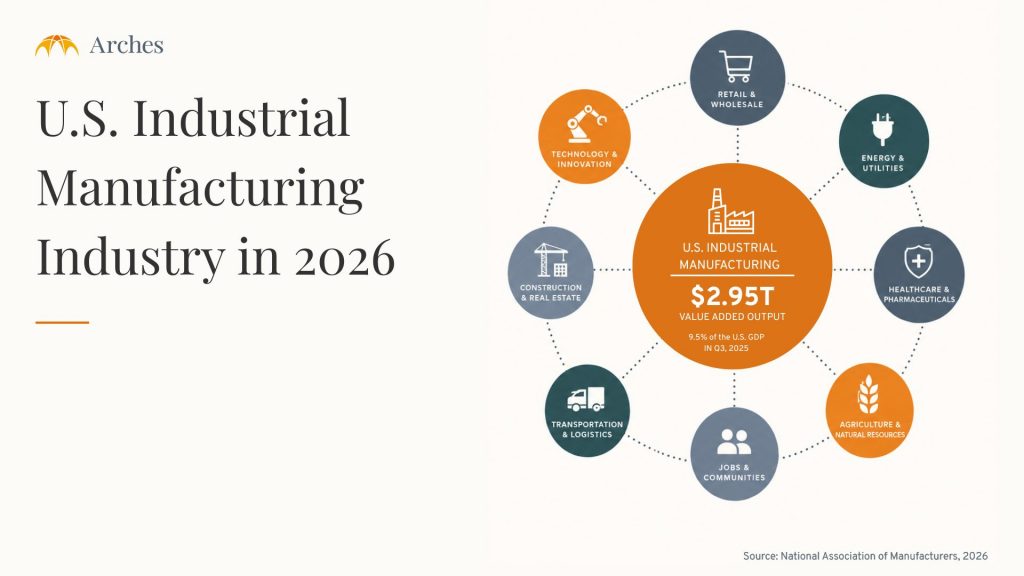
U.S. industrial manufacturing contributes $2.95 trillion in value-added output, making up 9.4% of U.S. GDP as of Q3 2025 (NAM, 2026). Decisions made here touch nearly every other part of the economy.
What makes 2026 different is the convergence of pressure from multiple directions at once:
- AI data centers are competing with steel, aluminum, and chemical plants for grid capacity, quietly pushing electricity costs higher for energy-intensive facilities
- A retirement wave is hollowing out the shop floor, and the institutional knowledge walking out with experienced workers cannot simply be rehired
- GE Aerospace’s $2 billion U.S. manufacturing commitment and MP Materials’ $1.25 billion rare earth magnet facility in Texas are early signals of an industrial investment wave moving faster than most operators can track (IndustrialSage, 2026)
The result is a market where published data may not keep up with the ground reality.
The Trends Reshaping U.S. Industrial Manufacturing 2026
1/ Reshoring Promises Are Outrunning Execution
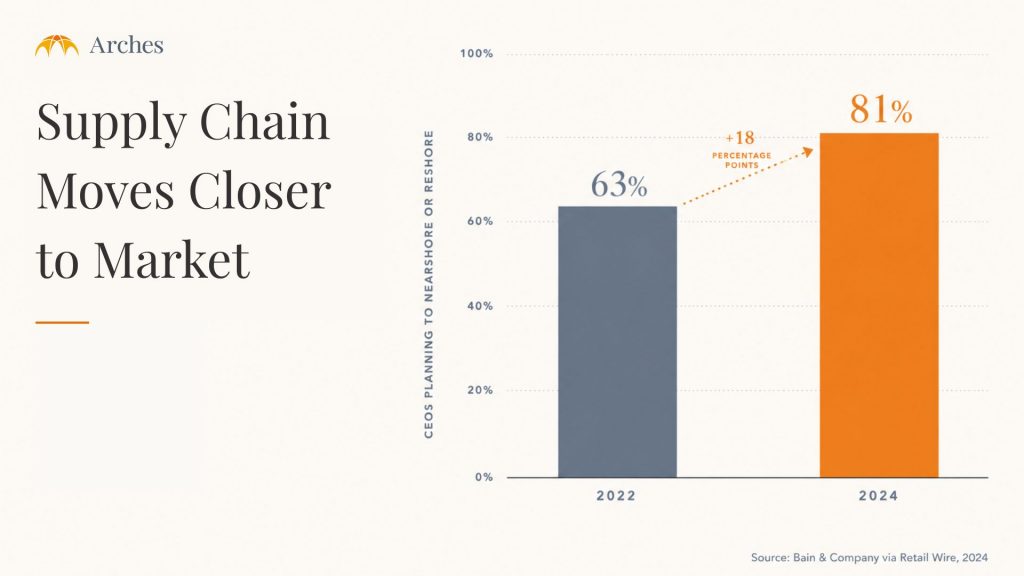
81% of CEOs now say they plan to nearshore or reshore, up from 63% in 2022 (Bain via Retail Wire, 2024). The announcements have been consistent and loud.
The construction data tells a quieter story. Manufacturing construction spending has declined 21% since its August 2024 peak, with non-electronics sectors seeing only a 5.6% increase since tariffs began (IoT Analytics, 2026). As IoT Analytics CEO Knud Lasse Lueth noted, one year after major public commitments, leading indicators still show little evidence of a genuine reshoring boom beyond a normal cyclical upswing.
For anyone doing factory validation or site due diligence, the headline numbers offer almost no signal. What matters is what is actually being executed at the facility level.
2/ Automation Is Splitting the Market in Two
Spending on manufacturing data management is forecast to hit $16.2 billion in 2026, up 8.7% year over year (ABI Research, 2026). At the large end of the market, AI-driven quality control, predictive maintenance, and robotics are moving from pilot to production.
But step into a mid-market plant and the picture often looks very different. Many operations still run the same way they did 20 years ago (Slalom, 2026). Two companies in the same sector can now sit in completely different operational realities:
- One is running AI-assisted line monitoring and remote diagnostics
- The other is still scheduling maintenance on a whiteboard
3/ Supply Chain Rewiring Is Creating New Blind Spots
Tariff pressure has pushed companies to move fast on sourcing. 65% are actively changing sourcing patterns and 57% are renegotiating supplier contracts (Thomson Reuters, 2026). Speed is necessary. But speed creates risk.
93% of executives report confidence in their overall supplier oversight, yet identify Tier 2 and Tier 3 suppliers as their most critical operational blind spots (Tradeverifyd, 2026). Companies think they know their supply chain. Most of the time they only know the first layer of it.
For procurement validation and supplier due diligence, this gap is exactly where the real story lives.
4/ The Labor Gap Becomes a Strategic Problem
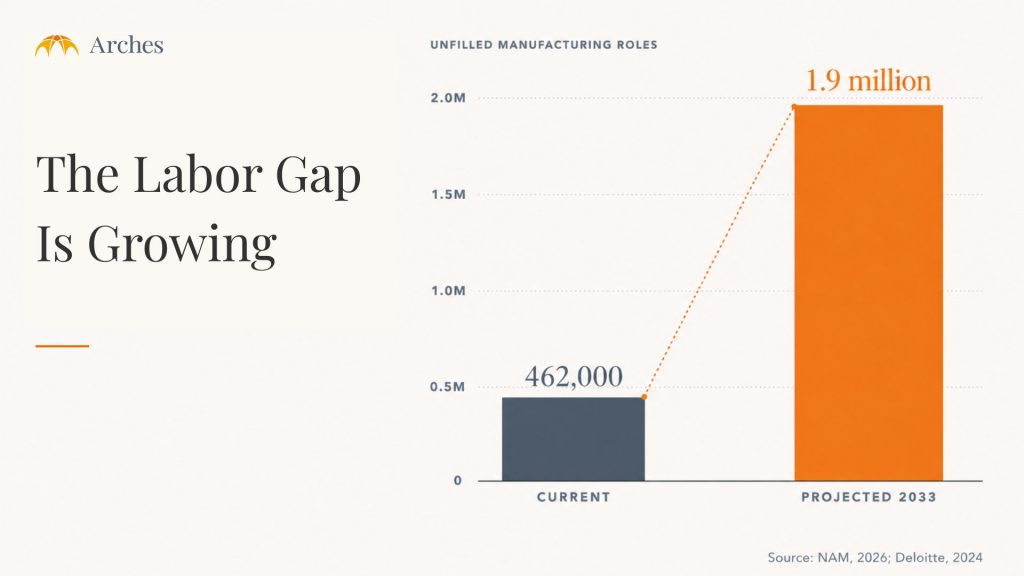
462,000 manufacturing roles are currently unfilled in the U.S. (NAM, 2026), with the gap projected to reach 1.9 million by 2033 (Deloitte, 2024). But the headline number understates the real problem.
Behind the labor gap sits a knowledge gap that continues to widen:
- Decades of process knowledge that was never formally documented
- Relationships with suppliers built over years
- An instinctive understanding of where a line breaks down and why
Forvis Mazars (2026) flags this as one of the most underappreciated risks in manufacturing modernization. No report captures the operational knowledge that leaves when an experienced plant manager retires.
How Leading Firms Stay Ahead in a Competitive Industrial Manufacturing Market
Consulting Directly from the Expertise
Strategy and research teams increasingly bypass published data as their primary source of validation. Instead, they go directly to the people who have operated in the environments they are trying to understand: plant managers, procurement leads, engineers, and operations directors.
The global expert consulting market reached approximately $3 billion in 2025 and is projected to exceed $4.86 billion by end of 2026, with an estimated 11,200 firms now using these platforms globally, a 150% increase since 2022 (Nexus Expert Research, 2026). The growth reflects a simple reality: data tells you what happened. Practitioners tell you what is happening and what comes next.
In industrial manufacturing, this matters more than almost any other sector. Use cases include factory validation, automation benchmarking, supplier due diligence, and reshoring feasibility checks.
How Arches Delivers the Manufacturing Insight That Moves Decisions Forward
Arches connects research and strategy teams to vetted operators across U.S. industrial and manufacturing sectors. Whether you are validating a factory acquisition, benchmarking automation maturity, or mapping supplier risk, Arches gives you fast access to the practitioners who can tell you what is actually happening on the floor.
- Direct access to operators, from plant managers to procurement leads and engineering specialists
- Structured interviews and due diligence calls, scoped to your project
- Fast turnaround from brief to first expert session
Beyond expert calls, there are multiple ways Arches supports research teams throughout the full project lifecycle.
FAQs
1/ What is the best expert consulting platform for industrial manufacturing research between GLG, Alphasight, Arches, Alphasense, Dialectica?
There is no single “best” healthcare expert network for every project. Each provider provides different approaches for each project scope.
At Arches, experts are recruited based on the specific brief of each project, ensuring alignment with the exact research context rather than relying solely on pre-existing panels. Just as importantly, Arches treats every opportunity, regardless of size.
2/ What types of experts are typically involved in industrial manufacturing consulting projects?
The most relevant profiles tend to be operations and plant managers, procurement and supply chain leads, automation and engineering specialists, and commercial leaders who understand how industrial buyers actually make decisions. The right mix depends on the research question.
→ Discover more industry perspectives across sectors from Healthcare to TMT in our News Collection.
→ Ready to scope your next project? Connect with Arches for a demo
- Follow Arches on LinkedIn to get the latest updates from us.
- Subscribe to Arches’ monthly newsletter for grounded perspectives from experts across Asia and beyond, where global decisions meet local insights.
