
Can I Decline a Paid Consulting Offer? What Happens When Experts Say No
For Experts

A paid consulting offer lands in the inbox, and it should feel like good news. Instead, it often comes with a small hesitation: is saying no going to cost something? Fair question, and one worth answering plainly before it gets in the way of a good opportunity.
This article walks through how the process works, what actually happens when an expert declines, and why saying no, when it makes sense, is simply part of doing this well.
How a Request Turns Into a Consultation
A quick look at how the process runs end to end makes it clear exactly where the decision to accept or decline comes in.
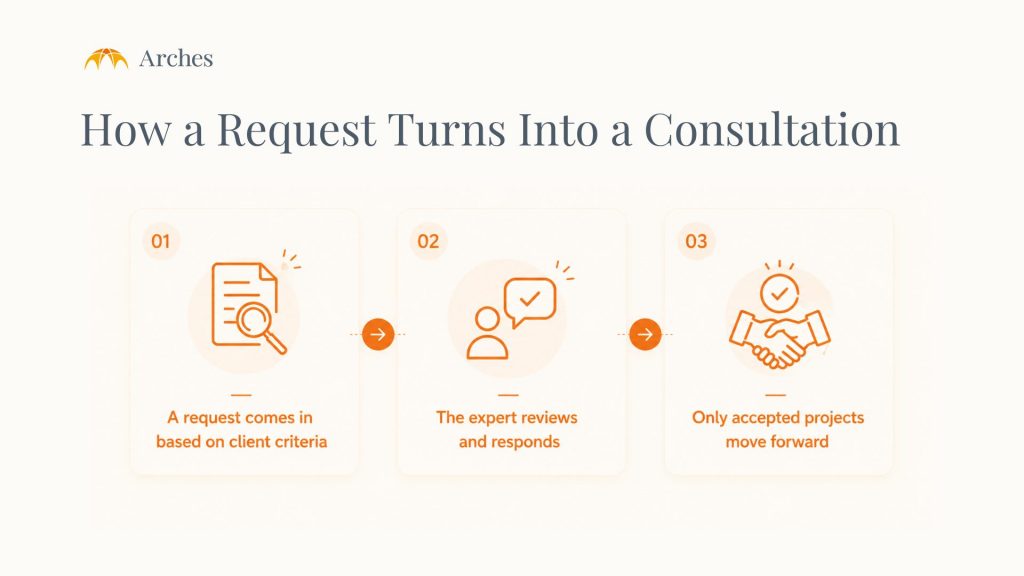
- A request comes in based on client criteria:
A client submits a request with specific requirements, and matching experts are contacted based on fit, not a rotating queue. Being contacted already means the background looks relevant on paper.
- The expert reviews and responds
Once contacted, an expert reviews the project details, including the topic, scope, and rate, and responds within a short window, typically confirming or declining within 24 hours.
- Only accepted projects move forward
A project only proceeds to scheduling once the expert has actively said yes. Nothing is assumed or auto-booked, and nothing is owed until that point. Declining at this stage simply ends the request. It does not trigger any penalty or payment obligation.
How to Evaluate a Project Before Saying Yes
Not every accepted invitation turns out to be a strong fit, and not every declined one should be. A few quick checks make that decision easier:
- Does the topic sit within direct, hands-on experience, not just peripheral exposure?
- Does the topic overlap with a current employer, competitor, or confidential information?
- Does the rate match the expert’s expectation?
For a full breakdown of how to weigh these factors before responding, see How to Evaluate Project Fit.
Why Declining Is a Normal Part of Paid Consulting
- Scheduling conflicts
The most common reason. This can mean a time overlap, a turnaround that is too tight to prepare for, or a week that is already full. Networks plan around this as routine. - Compliance or conflict of interest
Some cases call for declining, not just allow it: a current or recent employer, a direct competitor, or a topic that touches confidential or non-public information. Declining here protects both the expert’s professional standing and the integrity of the engagement, and it is standard practice, expected of every expert.
Saying No Does Not Close the Door
Declining a project is not a red flag. It just means that one was not the right fit, and the next one might be. Arches works to make sure most invitations are worth saying yes to in the first place, through:
- Clear project briefs before anything is confirmed. Objectives, key questions, and scope are defined upfront, so there is enough to make a real decision.
- Matching built on actual expertise. Opportunities are screened against background and seniority, not sent out broadly.
- Transparent coordination throughout. Clear timelines and steady communication from confirmation through payout.
Ready to see what a well-matched project actually looks like?
→ Join Arches as an expert and start receiving opportunities worth saying yes to.
FAQs:
Q: How does declining a project at Arches compare to networks like GLG or AlphaSights?
A: Across most established expert networks, including GLG and AlphaSights, declining a mismatched request is standard practice and a normal part of compliance. Arches follows the same principle, with the same care put into protecting an expert’s time and standing. The difference shows up earlier: projects are matched closely to an expert’s actual background before an invitation goes out, so there is rarely a need to decline in the first place.
Q: Is it normal to go weeks without a project request from an expert network?
A: Yes, and it does not mean an expert has been overlooked. Request volume depends entirely on client demand for a specific background at a given time, not on how active or responsive an expert has been. A quiet stretch is simply a gap in matching demand, and it can end as soon as a relevant project comes in.
- Follow Arches on LinkedIn for live updates.
- Subscribe to the Arches’ newsletter for monthly insights from our network across Asia and beyond.
