
Vietnam Green Energy in 2026: What Investors Need to Know
For Clients
Vietnam’s green energy transition is entering a new phase. Investment is no longer confined to renewable generation – it now extends into the infrastructure that makes that generation usable at scale.
Public discussion still centers on capacity targets under the revised PDP8. Investors face a narrower question: which financing structures support long-term returns, and which parts of the system remain difficult to finance.
The next competitive advantage in Vietnam’s power market belongs to those who can identify which layers of the system are becoming investable.
Why Vietnam’s Green Energy Investment Story Has Changed
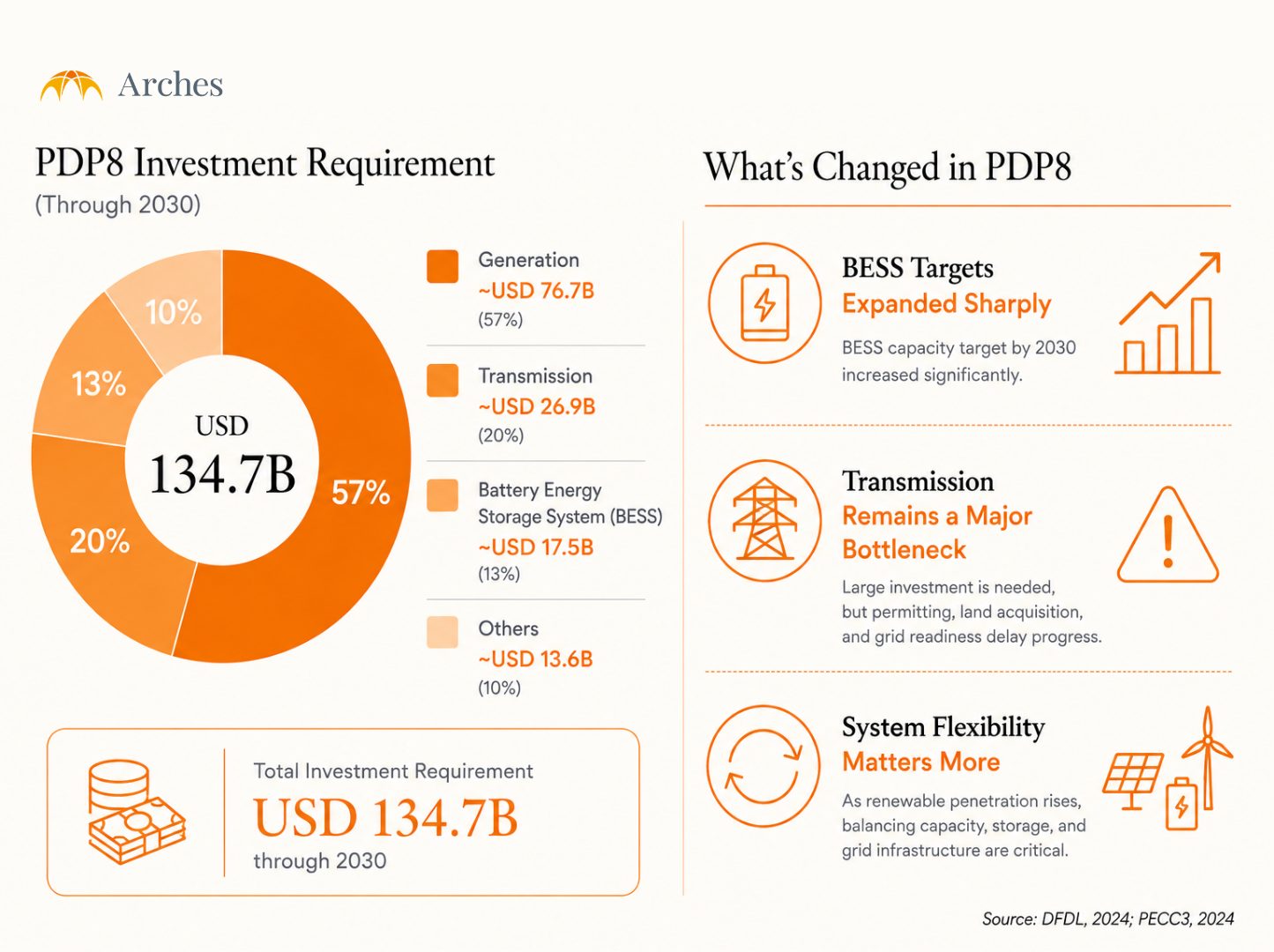
The revised PDP8 estimates a USD 134.7B investment requirement through 2030, according to DFDL. That figure alone doesn’t explain what’s changed – what matters is where the capital goes.
Generation still takes the largest share, but BESS targets have expanded sharply, and transmission remains one of the largest bottlenecks in the plan, per PECC3’s implementation review. As renewable penetration rises, grid infrastructure and system flexibility carry more weight than new generation alone.
Opportunity no longer sits in one segment. It spans generation, transmission, and storage, each governed by separate rules and separate capital.
Where Green Energy Investment Opportunities Are Emerging
Each infrastructure layer solves a different operational problem and attracts a different type of capital. Renewable generation, transmission, utility-scale BESS, and industrial energy management systems now behave as distinct asset classes with their own risk and return profiles.
Regulatory reform is improving visibility. Circular 62 introduces Vietnam’s first pricing framework for standalone BESS, according to Arcus Energy, while Decision 963 restructures time-of-use pricing. Across ASEAN, utility-scale storage is becoming more investable as similar frameworks mature, per Fessia’s research.
ESG investment is accelerating demand for this supporting infrastructure, since decarbonization commitments depend on grid flexibility as much as generation capacity. The task for investors is separating proven commercial models from those still awaiting regulatory clarity.
Key Insight: Green energy is no longer a single investment theme. Each infrastructure layer presents a different balance of risk, return, and regulatory maturity.
What Mature Green Energy Markets Reveal About Vietnam
Advanced energy markets typically progress through a structured evolution: capital initially flows toward generation, then transitions to transmission, before storage systems emerge to manage grid volatility from renewable integration, eventually concluding with demand-side flexibility.
Global BESS investment is gaining momentum as decarbonization targets intensify, with established markets shifting focus toward system flexibility, per data from the IEA and IRENA. Vietnam currently occupies the earlier stages of this progression, where generation capacity has matured rapidly, but frameworks for grid infrastructure and flexibility are still catching up.
For strategic investors, this serves as a benchmark rather than a forecast; the pace of capital absorption is driven by financing maturity rather than pure technological availability, as noted in Lofotr Investors’ institutional BESS research.
Key Insight: Technology creates opportunity, but financing frameworks determine how quickly investment scales.
How Investors Should Evaluate Vietnam’s Green Energy Market
Rather than treating Vietnam’s transition as one opportunity, investors should evaluate each segment on its own terms. Execution risk varies by layer – grid readiness, transmission constraints, permitting, project execution, and commercial viability each carry different weight depending on where capital is deployed.
Long-term value is likely to accumulate unevenly across developers, infrastructure owners, industrial users, and ESG-focused investors.
Decision Framework – questions investors should ask:
- Is the revenue model commercially proven?
- Does regulation support long-term returns?
- Can the transmission network support deployment?
- Which execution risks remain unresolved?
- Which assumptions require validation through expert interviews?
How Expert Insights Strengthen Green Energy Investment Decisions
Secondary research explains market direction well. It rarely captures how financing negotiations or local implementation unfold on the ground.
Expert interviews close that gap, validating assumptions before capital commitment rather than after.
→ Explore four ways expert networks close the gaps that secondary research alone can’t reach.
How Arches Supports Green Energy Research
Arches supports investors, developers, and corporate strategy teams through custom expert recruitment tailored to Vietnam’s green energy ecosystem.
With access to regulators, developers, financiers, ESG specialists, and industrial energy managers, plus a team spanning 15+ nationalities, Arches supports cross-border due diligence, market entry, and financing research across Vietnam and the wider APAC region.
→ Contact Arches to connect with the right experts for your next green energy research.
If your team is evaluating a new market and needs clarity before committing:
→ Check out our Expert Solution here
To discuss how Expert Solution is typically applied in real market entry decisions, meet Hoang Le, our Expert Solution | Consulting Manager, who works closely with corporate and consulting teams on early-stage market assessments across the region.

FAQ
What is driving Vietnam’s green energy transition?
Vietnam’s green energy transition is shifting beyond expanding renewable generation capacity to building a more integrated power system. Under the revised PDP8, investment is increasingly directed toward transmission infrastructure, battery energy storage systems (BESS), and industrial energy solutions, each requiring different financing models and regulatory frameworks. For investors, understanding how these layers interact is becoming just as important as tracking new renewable energy capacity.
Is Vietnam’s BESS market investable today?
Vietnam’s BESS market is becoming increasingly investable, supported by recent regulatory developments such as Circular 62, which introduces a pricing framework for standalone battery energy storage projects. While the market still faces challenges around grid infrastructure and broader private capital participation, utility-scale BESS is beginning to resemble an infrastructure asset with more predictable revenue mechanisms than traditional merchant power projects.
Follow Arches on LinkedIn for live updates.
Subscribe to the Arches’ newsletter for monthly insights from our network across Asia and beyond.
