
Rice Bran Oil in Vietnam: Market Research Case Study
Industry Insights

Rice bran oil is a refined cooking oil derived from rice milling by-products. An international food corporation identified the sector as a potential business opportunity in Vietnam. They were considering a prospective joint venture with a local agribusiness company, with the goal of manufacturing and distributing it in the domestic market.
Before moving forward, they needed to answer a fundamental question: Is there a real, viable business here? That meant understanding the full picture:
- The size and trajectory of the market
- The structure of the supply chain
- The competitive dynamics
- Whether Vietnamese consumers would actually buy rice bran oil, and at what price
Neither party had the in-country research capability to answer these questions rigorously. They engaged Arches to conduct a comprehensive market assessment and deliver the evidence needed to support a sound investment decision.
Why Rice Bran Oil Research in Vietnam Is Challenging
The difficulty of this rice bran oil project came from three structural factors.
Limited secondary data
Rice bran oil sits in an unusual position in Vietnam’s consumer market. It is not a niche product, but it has yet to reach mainstream penetration. As a result, published data on the category is limited and often unreliable. There was no shortcut to understanding the market. The numbers had to be built from the ground up.
A fragmented value chain
The supply chain presented its own complexity. It spans raw material suppliers, domestic and overseas manufacturers, distributors, retail and food service end-users, and by-product buyers. Each operates with different incentives and limited visibility. Understanding how the industry works required mapping every layer.
Different priorities and perspectives
Another challenge came from the two clients. They had overlapping but not identical interests, and both needed clear answers from the same research process.
There was almost no usable secondary data, and no single stakeholder could fully describe the rice bran oil value chain. The only way to build a reliable market picture was to combine desk research with direct, primary research across the industry.
Rice Bran Oil: 4 Research Approaches Our Team Conducted
Given these constraints, the team designed a combined approach using both secondary and primary research. Each method addressed a specific gap in the market.
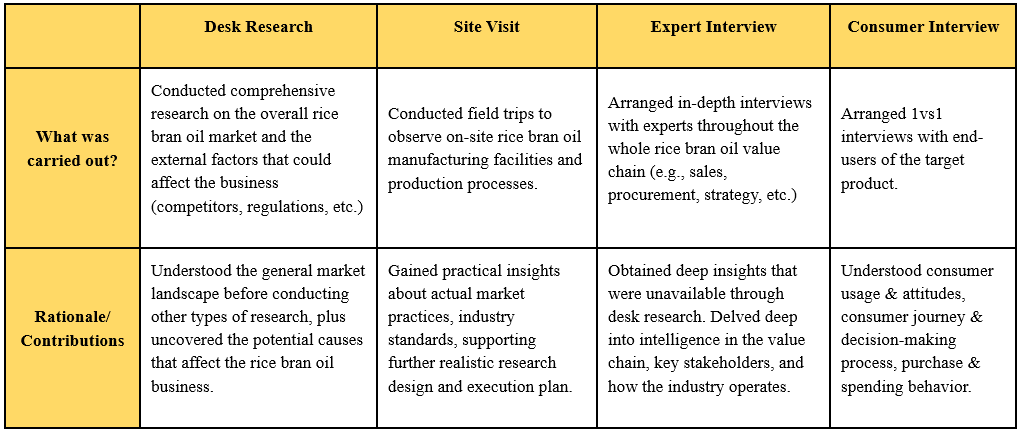
Table 1: The Expert Solution team combined 4 approaches to draw the rice bran oil market picture
Arches designed a four-method framework combining desk research with on-the-ground fieldwork to capture what secondary sources alone could not provide for the rice bran oil market.
Desk research laid the foundation by mapping the competitive landscape, regulatory environment, and pricing dynamics across channels. From there, Arches’ Vietnam-based team conducted site visits to rice bran oil manufacturing facilities, using local experience to interpret operational realities in context.
Expert interviews were critical to understanding the rice bran oil value chain. Reaching practitioners with direct experience in sales, procurement, and distribution is often difficult. Arches leveraged a proprietary network of 160,000+ experts across Asia to access relevant stakeholders efficiently.
Consumer interviews completed the picture. Both parties gained a clear view of how Vietnamese consumers perceive and purchase rice bran oil, insights not available through secondary sources.
The full engagement was completed in three months, delivering a level of depth that would typically take longer through conventional approaches.
Key Research Findings: Vietnam Rice Bran Oil Market Dynamics
Market size & Growth potential:
The rice bran oil market size was estimated by combining secondary data on pricing across channels (MT, GT, e-commerce) with primary insights from expert interviews and trade data, providing a holistic view of domestic consumption as well as import and export dynamics. Despite the relatively small size of the rice bran oil category, it shows steady growth potential over the next 5–10 years. To enter the rice bran oil market, the company may need to not only take market share from current players, but also expand overall consumption of rice bran oil.
Value chain & industry practices:
The rice bran oil industry is structurally complex, spanning both end-user sales and by-product markets, which directly impacts profitability if not effectively managed. This requires strong operational discipline and strategic commitment. Without it, new entrants risk losing out to dominant players in the rice bran oil market.
Consumer engagement tactics:
Consumers are generally price-sensitive and may be reluctant to switch to higher-priced alternatives without clear value justification. However, rising health awareness among Vietnamese consumers presents a strong growth opportunity for rice bran oil. With targeted marketing, channel-specific engagement, and consumer education, the product can effectively build traction in the market.
What the Clients Walked Away With
After three months, Arches delivered a comprehensive output covering the rice bran oil market. The research addressed market sizing, value chain mapping, competitive dynamics, consumer behavior, and trade flows.
Both parties gained a clear and realistic understanding of the rice bran oil opportunity.
Beyond the findings, Arches provided actionable recommendations for entering the rice bran oil market. These were grounded in local expertise and primary research.
The clients left with not just data, but direction. The decision to pursue a rice bran oil joint venture could now be made on an evidence-based foundation.
A Final Note on Rice Bran Oil and Market Entry Research in Vietnam
Most market entry projects in Asia stall for the same reason: the research relies on data that either doesn’t exist or can’t be trusted. Published figures are thin. Industry reports are dated. And the people who actually know how a market works: the operators, the buyers, the distributors, are not easy to reach.
This is where Arches operates differently. With a proprietary network of 160,000+ experts across Asia and an in-country team embedded in Vietnam for nearly a decade, we don’t depend on what’s publicly available. We go directly to the people who hold the real answers, and we do it faster and at a fraction of the cost of traditional consulting firms.
For this project, that meant getting into manufacturing facilities, sitting across from value chain practitioners who rarely speak to outsiders, and running direct consumer interviews to validate what the data could not confirm. The result was a market picture that didn’t exist anywhere before we built it.
That is the work that makes the difference between a business decision built on assumptions and one built on evidence.
→ Read more about Expert Solution
To discuss how Expert Solution is typically applied in real market entry decisions, meet Hoang Le, our Expert Solution | Consulting Manager, who works closely with corporate and consulting teams on early-stage market assessments across the region.

Relevant cases and articles:
Valid Thai Market Insights, No Business Trip Needed
Sustainability Rises, Home Appliance Struggles to Keep Up
Beyond Expert Calls: 4 Ways Expert Networks Help Close Information Gaps
Expert Network Pricing Explained: Is Arches Expensive?
Follow Arches on LinkedIn to get the latest updates from us.
Subscribe to Arches’ monthly newsletter for grounded perspectives from experts across Asia and beyond, where global decisions meet local insights.
