
Vietnam Food and Beverage Global Expansion: How They’re Doing It and What It Reveals
Industry Insights
Food and beverage (FnB) has long been one of Vietnam’s most competitive sectors. Over the past decade, international chains have built deep presence across provinces and consumer segments, supported by mature systems and scalable operating models.
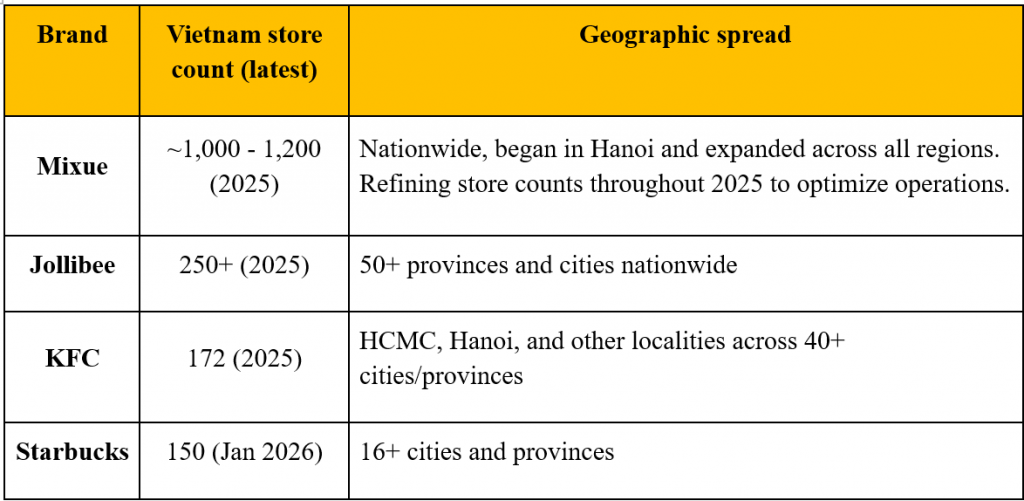
Source: Arches Global team desk research and synthesis
These players did not scale overnight. Their expansion reflects years of investment in supply chains, operations, and localization.
Now, Vietnamese food and beverage brands are moving outward. A growing group of domestic chains is entering international markets, offering useful signals for foreign companies evaluating Vietnam as a partner ecosystem.
The Food and Beverage Category: Not All Concepts Travel Equally
In this industry, product structure determines scalability.
Beverages, especially coffee and tea, are the most exportable formats. Preparation is standardized, ingredients are easier to manage and preserve, though sourcing dependencies, particularly for Vietnamese coffee brands, do not disappear with scale. Similarly, consumption habits translate more easily across markets. This makes beverage-led food and beverage brands structurally advantaged in global expansion.
By contrast, traditional cuisine faces friction. Complex preparation, fresh ingredients, and regional variation increase operational burden. Food and beverage brands like Pho 24 and Wrap & Roll illustrate this challenge: both expanded internationally, but later retrenched due to a weak operating foundation rather than a lack of brand appeal.
Three Expansion Paths, and What They Signal
Vietnamese food and beverage brands expanding globally tend to follow three models:
1. Organic expansion
Company-owned stores offer full control over brand and operations. This model protects quality but requires capital and exposes internal capability gaps. For a food and beverage brand, this is the slowest path.
2. Strategic partnerships and joint ventures
Working with local operators accelerates entry by leveraging existing infrastructure. However, brands must manage consistency across partners, something many are still developing.
3. Franchising
Franchising is increasingly popular in this sector due to its asset-light scaling. But it requires strong systems, documentation, and governance. Without these, brand dilution becomes a real risk.
Most Vietnamese food and beverage brands are not committing to a single model. Instead, they are experimenting across approaches depending on market conditions, reflecting both pragmatism and early-stage international maturity.
Entry timing also shapes outcomes independently of model choice. Food and beverage brands entering a market early gain positioning but face uncertain demand. Late entrants find more validated markets but face established competition from both international chains and local incumbents, the same dynamic that separated KFC’s dominance from McDonald’s slow start in Vietnam applies equally to Vietnamese brands expanding abroad.
What the FnB Global Expansion Cases in Vietnam Actually Show
Current food and beverage expansion outcomes are mixed.
Highlands Coffee represents one of the strongest cases. Under Jollibee Foods Corporation, it enabled access to capital, infrastructure, and local expertise. With 38 stores in the Philippines, this shows how food and beverage expansion can work when supported by strong partners.
Cong Ca Phe takes a different route. Its distinctly Vietnamese identity is the core export. With around 20 international stores, it demonstrates that cultural specificity can travel, but scale remains uncertain.
Meanwhile, Pho 24 and Wrap & Roll highlight a common pattern: both had credible concepts and real consumer appeal, but expansion stalled when their operating systems could not maintain consistency at scale.
Trung Nguyen Legend has the longest international trajectory, yet still lacks large-scale overseas momentum. Its ambitions remain ahead of its realized footprint.
Across all cases, a key benchmark, 30 to 50 new international stores annually, remains unmet. This suggests Vietnamese food and beverage brands are still in early-stage global scaling.
The Core Tension in Food and Beverage Expansion
Every food and beverage brand expanding globally faces the same trade-off: adaptation versus authenticity.
Vietnamese brands derive value from cultural specificity, flavors, rituals, and identity. This distinctiveness is their advantage internationally.
But it is also difficult to scale.
- Over-adaptation risks losing identity
- Over-preservation limits market resonance
Most Vietnamese food and beverage brands are still navigating this balance. It remains an open strategic question rather than a solved formula.
What This Means for Food and Beverage Partnerships
For foreign companies evaluating Vietnamese food and beverage partners, several patterns stand out:
1. Strong concept creation
Vietnamese food and beverage brands excel at product quality, brand identity, and consumer understanding, shaped by intense domestic competition.
2. Developing operational systems
Cross-market scalability, systems, governance, and consistency are still being built. These are not yet reliable strengths across the sector.
3. Partnership culture is early, and forming
For foreign companies, this openness is a real advantage. But it comes with a systems gap to account for. The most productive partnerships are those where the foreign party brings operational depth and capital stability. While leaving room for the Vietnamese brand’s identity to remain intact.
Vietnamese Food and Beverage: Early Stage, Real Potential
Vietnamese food and beverage global expansion is not yet a proven model. It is still evolving, shaped by experimentation across markets and partnerships.
For foreign companies, the key question is not which food and beverage brands have already “made it,” but what kind of partner Vietnamese brands represent today.
The answer right now: capable, motivated, and culturally distinctive, with systems still catching up to ambition. That gap is where the most interesting opportunities tend to start.
When evaluating partnerships or market entry, you will need a grounded read on specific companies or market dynamics, which is the kind of intelligence Arches is built for.
→ Read more about Expert Solution
To discuss how Expert Solution is typically applied in real market entry decisions, meet Hoang Le, our Expert Solution | Consulting Manager, who works closely with corporate and consulting teams on early-stage market assessments across the region.

Relevant Testimonials
Valid Thai Market Insights, No Business Trip Needed
Sustainability Rises, Home Appliance Struggles to Keep Up
Beyond Expert Calls: 4 Ways Expert Networks Help Close Information Gaps
Expert Network Pricing Explained: Is Arches Expensive?
Follow Arches on LinkedIn to get the latest updates from us.
Subscribe to Arches’ monthly newsletter for grounded perspectives from experts across Asia and beyond, where global decisions meet local insights.
